Subscribe
The latest psychology and neuroscience discoveries.
My Account
  • Mental Health
  • Social Psychology
  • Cognitive Science
  • Neuroscience
  • About
No Result
View All Result
PsyPost
PsyPost
No Result
View All Result
Home Exclusive Social Psychology Political Psychology

Study finds political moralization can even infect opinions about unrelated consumer products

by Eric W. Dolan
October 14, 2017
in Political Psychology
Donald Trump speaking with supporters at a campaign rally at the Phoenix Convention Center in Phoenix, Arizona in 2016. (Photo credit: Gage Skidmore)

Donald Trump speaking with supporters at a campaign rally at the Phoenix Convention Center in Phoenix, Arizona in 2016. (Photo credit: Gage Skidmore)

Share on TwitterShare on Facebook

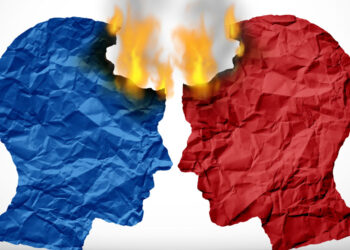
Research has found that people have a natural tendency to conform to the opinion of the majority. But a new study indicates that this tendency can be reversed when the majority is a strongly morally opposed outgroup.

The study, published Journal of Experimental Social Psychology, provides some clues about the growing political polarization in the United States.

“My general interest is in how people use things other than logic and value maximization to make decisions, and in particular how group memberships shape decisions,” said study author Randy Stein of Cal Poly Pomona. “So, looking at decisions in the context of political groups was a pretty natural extension of that, and a pretty clear way to stress the importance of the topic.”

Across three studies of 784 Americans, Stein found the typical tendency to conform to the opinion of a majority did not extend to groups outside of a person’s moral circle.

The participants were asked a number of non-political questions about consumer products, such as “Would you rather have a car that is forest green or silver?” and “Would you rather have a Dirt Devil or Hoover vacuum cleaner?”

After each question, they saw a new screen with a sentence such as “79% of Trump supporters chose forest green” or “85% of Americans chose Hoover.” The majority group opinions of Canadians, Clinton supporters, liberals, conservatives, pro-choice supporters, pro-life supporters, gays & lesbians, Christians, and white supremacists were also used.

The participants were then asked to answer the same questions again and re-state their previous answer a second time.

Stein found that when the majority group was “Americans” or another group participants belonged to, they felt an urge to shift their preferences in that direction.

Google News Preferences Add PsyPost to your preferred sources

But when a person morally opposed to Clinton was shown the opinion of Clinton supporters, the opposite effect occurred. The same was true of those morally opposed to Trump, those morally opposed to liberalism, those morally opposed to white supremacists, et cetera.

“I think the most important implication of recent research into motivated/group-based cognition (of which I’d say this article is a part) is that, even though we experience important decisions as made by us for the purpose of maximizing our own interests, decisions might better be described as a way of calibrating group memberships – a strategy to increase or reduce distance to certain groups,” Stein told PsyPost.

“My studies in particular suggest that, when dealing with moralized groups, by the time people start to think about decisions they’re already urged towards polarized outcomes.”

The researchers asked the participants about their urge to change their preference. But does that mean they actually would?

“The major caveat is that the ‘urges’ described in my studies aren’t the only input into decisions. People have those partisan urges, it doesn’t mean the urges rule behavior,” Stein explained.

“By this point it’s pretty well-established in the group cognition literature that people are quite good at maneuvering decisions in ways that reaffirm important group identities (in particular moral identities). So the big question that’s just starting to be addressed is what happens in those relatively rare instances when people do stop conforming to their moral ingroups.”

The study was titled:”‘Trumping; conformity: Urges towards conformity to ingroups and nonconformity to morally opposed outgroups“.

Previous Post

Psychologists investigate: What are the best ways to infiltrate a romantic relationship?

Next Post

Scientists find your Facebook likes can accurately predict who you’re going to vote for

RELATED

People consistently overestimate the social backlash of changing their political beliefs, new psychology research shows
Political Psychology

People consistently overestimate the social backlash of changing their political beliefs, new psychology research shows

March 15, 2026
Contact with a service dog might help individuals with PTSD sleep better, study finds
Political Psychology

Veterans are no more likely than the general public to support political violence

March 13, 2026
A single Trump tweet has been connected to a rise in arrests of white Americans
Donald Trump

Texas migrant buses boosted Donald Trump’s vote share in targeted cities

March 12, 2026
New psychology research sheds light on the mystery of deja vu
Political Psychology

Black Lives Matter protests sparked a short-term conservative backlash but ultimately shifted the 2020 election towards Democrats

March 9, 2026
A psychological need for certainty is associated with radical right voting
Personality Psychology

A psychological need for certainty is associated with radical right voting

March 7, 2026
Pro-environmental behavior is exaggerated on self-report questionnaires, particularly among those with stronger environmentalist identity
Climate

Conservatives underestimate the environmental impact of sustainable behaviors compared to liberals

March 5, 2026
Common left-right political scale masks anti-establishment views at the center
Political Psychology

American issue polarization surged after 2008 as the left moved further left

March 5, 2026
Evolutionary psychology reveals patterns in mass murder motivations across life stages
Authoritarianism

Psychological network analysis reveals how inner self-compassion connects to outward social attitudes

March 5, 2026

STAY CONNECTED

LATEST

Children with attention disorders struggle to process whole faces during social interactions

Self-guided mental imagery training shows promise in reducing anxiety

People consistently overestimate the social backlash of changing their political beliefs, new psychology research shows

Watching violent Black video game characters increases unconscious bias in White viewers

Childhood trauma leaves a lasting mark on biological systems, study finds

How dark personality traits predict digital abuse in romantic relationships

Intrinsic capacity scores predict the risk of mild cognitive impairment in older adults

Laughter plays a unique role in building a secure father-child relationship, new research suggests

PsyPost is a psychology and neuroscience news website dedicated to reporting the latest research on human behavior, cognition, and society. (READ MORE...)

  • Mental Health
  • Neuroimaging
  • Personality Psychology
  • Social Psychology
  • Artificial Intelligence
  • Cognitive Science
  • Psychopharmacology
  • Contact us
  • Disclaimer
  • Privacy policy
  • Terms and conditions
  • Do not sell my personal information

(c) PsyPost Media Inc

Welcome Back!

Login to your account below

Forgotten Password?

Retrieve your password

Please enter your username or email address to reset your password.

Log In

Add New Playlist

Subscribe
  • My Account
  • Cognitive Science Research
  • Mental Health Research
  • Social Psychology Research
  • Drug Research
  • Relationship Research
  • About PsyPost
  • Contact
  • Privacy Policy

(c) PsyPost Media Inc