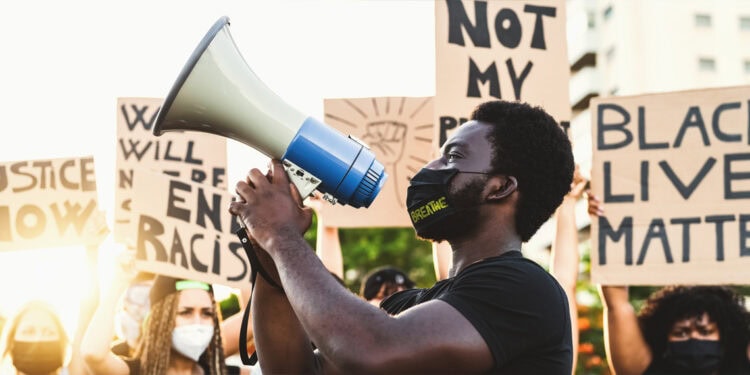

New research sheds light on the role of coalitional affiliation in shaping emotional responses to intergroup conflicts. The findings, published in Royal Society Open Science, indicate that political orientation modulates whether people feel inspired and uplifted after watching a video of large-scale protests demanding racial equity in policing.
The authors behind the new study sought to investigate how coalitional affiliation influenced experiences of moral elevation in the context of a prominent and politically divisive social conflict in the United States: the Black Lives Matters movement.
“The 2020 protests against racial bias in policing were the largest political protests in U.S. history,” explained study author Colin Holbrook, an associate professor of cognitive and information sciences at the University of California, Merced.
“These protests, and the ‘Back the Blue’ counter-protests, provided a real-world opportunity to study the role of an emotion previously associated with cooperation, prosociality, love and helpfulness in the context of group conflict. Although charitable giving and similar acts of kindness are probably the first things to come to mind when you think about helping, conflict should also arouse emotions motivating efforts to work together to help one’s side prevail.”
The researchers conducted two separate studies in 2020 while the BLM protests were happening across the United States. The studies included 2,172 U.S. adults, who were recruited via Amazon Mechanical Turk.
In Study 1, they recruited participants from an online platform and showed them videos either depicting BLM protesters or neutral scenes. After watching the videos, participants were asked to report their emotions and their preferences regarding increasing or decreasing police funding. The researchers were specifically interested in a feeling called “elevation,” which is a positive emotion that inspires people to be more cooperative and helpful. They used a scale to measure participants’ elevation levels.
“Elevation is an emotion which has only recently been named in English, but which research has proven to be a real and distinct emotion, just as happiness, pride, anger, awe, disgust, fear or gratitude are all distinct emotions,” Holbrook explained. “Feelings of elevation are inspired when we see people perform altruistic acts for others. Elevation involves bodily feelings such as goosebumps, warm sensations, and tears, as well as desire to be a more helpful and giving person.”
The researchers also collected information about participants’ political orientation and their perceptions of police as prosocial cooperative partners. They used a self-report measure where participants indicated their agreement or disagreement with various political issues. Additionally, demographic information such as age, gender, and race was collected.
In Study 2, the researchers followed a similar procedure but added an additional video depicting “Back the Blue” (BtB) protesters, who support the police. They wanted to see how this video would elicit elevation and affect participants’ preferences regarding police funding. The same measurements and questionnaires from Study 1 were used in Study 2.
The researchers found that participants’ political orientation influenced whether they experienced moral elevation while watching a video of large-scale protests for racial equity or a counter-protest video. Conservatives experienced elevation in response to the BtB video, while liberals experienced elevation in response to the BLM video.
Furthermore, the state of elevation experienced by participants in response to the videos was associated with their preferences regarding funding for the police. Elevation evoked by the BLM video was related to a preference for defunding the police, while elevation evoked by the BtB video was related to a preference for increasing police funding. These findings indicate that people’s political attitudes and coalitional affiliation influence their emotional responses and preferences regarding the allocation of funds to policing and social services.
“We found that conservatives felt elevation when watching anti-BLM counter-protests, progressives felt elevation when watching BLM protests, and that feelings of elevation predicted desire to either increase or decrease police funding depending on which side the participants were on,” Holbrook told PsyPost. “These results show that the same actions or policies can be experienced as moral, and as emotionally moving, in opposite directions depending on our group biases.”
“Morality is in the eye of the beholder. Enemies we may intuitively perceive as driven by hate may be driven by prosocial feelings and emotions. Understanding their moral feelings and motivations may be useful when negotiating with — or even strategizing against — members of opposing groups.”
The researchers argue that the interactions between coalitional attitudes and state elevation observed in this study are likely to be even more pronounced in contexts of overtly violent intergroup conflicts. They also suggest that elevation and other positive emotions can contribute to a social-emotional feedback loop that hinders compromise and escalates conflict, as these feelings may reinforce the perception of one’s own group’s struggle as morally righteous and discourage openness to negotiation.
“Our model of conflict, cooperation, and elevation applies to all conflicts, and should be tested in other contexts, including active wars,” Holbrook said. “Our work also speaks to the function of propaganda to frame one’s side as morally righteous. The capacity to inspire elevation among other emotions on behalf of one’s side, may be critical to mobilizing cooperation and victory in societal conflicts. Individuals who do not perceive their side’s cause as morally justified should be less willing to cooperate, and less susceptible to emotional manipulation by leaders or media.”
The study, “Coalitionality shapes moral elevation: evidence from the U.S. Black Lives Matter protest and counter-protest movements“, was authored by Colin Holbrook, Daniel M. T. Fessler, Adam Maxwell Sparks, Devin L. Johnson, Theodore Samore, and Lawrence I. Reed.