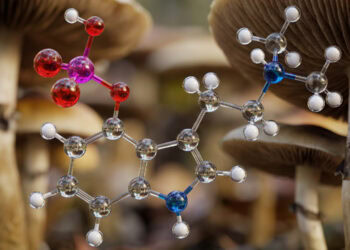
New research suggests that the public’s perception of the potential harms of magic mushrooms is not in line with drug laws. The study, which appears in the Journal of Psychopharmacology, found that psilocybin-containing mushrooms are considered less dangerous than alcohol, tobacco, and other substances.
“I am a psychopharmacologist at the University of Liverpool, so I have a great interest in how substances affect the brain and behavior,” said study author Carl Roberts, a lecturer in the university’s department of psychology.
“I have long been following the resurgence in research with psychedelics such as psilocybin for therapeutic potential. I knew this research area had been gaining quite a lot of attention recently. I also knew that the data on actual harm of magic mushroom use suggested that toxicity and abuse potential was low.”
“However, they are classified as a Class A drug in the UK – suggesting the same relative harm as heroin and cocaine,” Roberts explained. “So I was interested to see what the public’s perceptions of harms around magic mushrooms were – i.e. are they in line with government legal classifications, or are they in line with the scientific evidence?”
For their study, the researchers asked 151 participants to rank the dangerousness of ten different substances: alcohol, tobacco, prescription opiates, heroin, cocaine, ecstasy, magic mushrooms, cannabis, LSD, and GHB.
The participants were recruited from various websites and social media pages that provide information about recreational drug use. Nearly half of them were from the United Kingdom, while approximately 21% were from the United States. The remaining participants were from countries in the European Union.
Despite magic mushrooms being a Schedule I substance in the United States and a Class A substance in the United Kingdom — the most restrictive categories — the researchers found that most participants considered magic mushrooms to be relatively safe compared to the other substances.
Those who had previously used magic mushrooms ranked it as the least dangerous substance. Those who had never used magic mushrooms, on the other hand, ranked it as the second to least most dangerous substance. (Non-users ranked cannabis as the least dangerous substance.)
“Both people with a history of using magic mushrooms, and those who were non-users considered magic mushrooms to be less dangerous than heroin (Class A), cocaine (Class A), prescription pain-killers (legal with prescription), GHB (Class C), ecstasy (Class A), tobacco (legal) and alcohol (legal),” Roberts told PsyPost.
“This suggests a general perception of harm of magic mushrooms that is in line with data on actual harm (abuse potential and toxicity) and the scientifically recognized relative harms of psilocybin mushrooms compared to other drugs. This indicates that public health messaging based on scientific evidence about relative harms of drugs are seen as more credible information sources than government legal drugs classification systems.”
But the study — like all research — includes some caveats.
“This was an online survey style study. As such, there is a potential selection bias here, in that perhaps only participants who are interested in this research area took part. Thus a much larger random sample would be necessary to properly gauge general public perception,” Roberts explained.
“In addition, this study provides no information about potential negative long-term health effects of using psilocybin mushrooms in controlled and uncontrolled settings, which is something that requires further research.”
“While magic mushrooms were ranked as less dangerous than several other legal and illegal substances in our sample, this does not mean that they are considered to have no harm at all,” Roberts added. “Rather, that relative to other drugs, perception of harm is low. Indeed, there are documented cases of adverse reactions and other complications associated with magic mushroom use.”
The study, “Perceived harm, motivations for use and subjective experiences of recreational psychedelic ‘magic’ mushroom use“, Carl A Roberts, Isaac Osborne-Miller, Jon Cole, Suzanne H Gage, and Paul Christiansen.