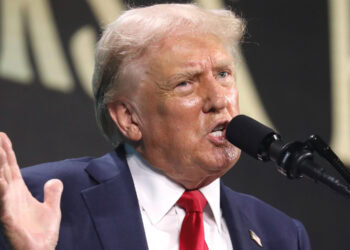
Teenagers in the United States are informed about their political world and capable of effectively evaluating political leaders, including President Donald Trump.
This statement runs counter to stereotypes that adults tend to hold about teens. Ask most adults to describe the political abilities of the typical American adolescent and you may hear words like “apathetic,” “uninformed” and “immature.”
But a study I conducted in 2017 with Laura-Wray Lake of UCLA, Amy Syvertsen of the Search Institute and two of my graduate students, Lauren Alvis and Katelyn Romm, indicates that high school students are much more knowledgeable – and have stronger feelings – about their political world than they are usually given credit for.
We asked more than 1,400 high school students in grades 9 to 12 to evaluate President Trump and provide reasons for their approval or disapproval of the president. The teenagers came from Southern California near Los Angeles, suburban Minnesota and rural West Virginia. They were diverse – 43% identified as Latino, 34% as white, 13% as African American and 6% as Asian American – and lived in communities that support and oppose Trump.
A wide range of views
Several key themes emerged from the responses.
One was enthusiasm. Teens had a lot to say about Trump. Both youth who approved of Trump and those who did not provided thoughtful reasons for their views of the president. Many youth wrote sophisticated responses that counter stereotypes of adolescents as indifferent to their political world.
Another theme was knowledge. Teens supported their views by pointing to specific policies or statements by the president. Many of them justified their opinions by mentioning Trump’s policies on social and political issues such as economic policy, abortion and relationships with foreign countries.
A large percentage of teens mentioned immigration, pointing to specific Trump statements or policy proposals, like the construction of a border wall between the United States and Mexico.
An 18-year-old female, for example, expressed her approval of Trump’s immigration policies: “Regarding issues with immigrants and stuff, I am not completely against it. I think we should be more aware of who and what kind of people we are allowing into our country, to keep everyone safe.”
A 15-year-old white female had this to say about Trump’s border policies: “I just don’t understand how that would make us great again. Because America is made up of immigrants, so it wouldn’t be America if he didn’t allow immigrants.”
Teenagers also demonstrated knowledge of the president’s leadership style and background. Many of them mentioned Trump’s business portfolio or his extensive Twitter use as a communication tool.
“I feel that [Trump] will bring more jobs to the economy since he is a businessman,” said a 17-year-old Latina.
On the other hand, youth who disapproved of Trump pointed to his lack of political experience.
Strong beliefs
Political beliefs varied greatly among adolescents, with many teens expressing strong approval or disapproval of the president in a way that echoed the range of views we see among adult voters.
“Trump is going to do many things such as lower taxes, repeal Obamacare and try to institute the travel ban,” wrote an 18-year-old white male. “He also is not going to be a gun control freak.”
A 17-year-old African American female said: “I give [Trump] some credit because he is against abortion and gay marriage.”
By contrast, a 15-year-old white female from Minnesota wrote: “President Trump is a climate change denier. He also is in support of ‘defending the Second Amendment,’ which I also believe in. However, I also understand that gun violence is rampant in the United States and needs to be regulated more heavily.”
Bashing stereotypes
The responses we gathered help counter another stereotype about American adolescents: that they are overwhelmingly liberal and likely to vote for Democratic candidates.
Yes, younger generations lean more liberal on some social and political issues compared to older generations. But our study indicates that it’s inaccurate to generalize about teens’ political inclinations, because they hold a full range of views.
Teen views of Trump, like those of adults, were strongly related to where they live. Overwhelming majorities of adolescents in Southern California (85%) and Minnesota (84%) disapproved of Trump, but a majority of youth in West Virginia held positive views (66%). Adolescents with more conservative parents were more likely to approve of Trump, while youth from more liberal homes more strongly disapproved of the president. White youth generally held more favorable views of Trump, while females and black and Latino youth tended to reject him.
Personal stake
Our study also helps counter the notion that adolescents are not directly affected by political activity, that they have “no skin in the game.”
Adolescents in rural West Virginia underlined how Trump’s energy policies could directly affect family members employed by power plants or coal mines. This is how one 14-year-old white female put it: “I am happy Donald Trump is our president because my dad works for a power company, and that is how we made the majority of our money. Without his job we would have a hard time buying medicines and taking care of everyone in my family.”
Many teen Trump skeptics from Southern California noted how his proposed immigration policies could threaten their families or neighborhoods. A 15-year-old Latina, for instance, noted: “I am very scared [Trump] will harm my family. My parents are not from this country, but they do the best they can to be here with us and have us live the American dream.”
Sensitivity to discrimination
One final theme present in our study highlights issues that will weigh on younger voters in the 2020 election and beyond. A large percentage of responses were framed around issues of racism, sexism and homophobia. Over half of the youth who dismiss Trump viewed his policies as potentially biased or loaded with discriminatory rhetoric, which is consistent with data indicating that younger generations are more attuned to issues of equity.
These concerns were not limited to any one group of teens. For example, an 18-year-old white male from West Virginia said, “[Trump] is misogynistic and sexually offensive as audio clips of Donald Trump would prove more than once … going as far to make fun of a disabled man in front of national television.”
As this response shows, teenagers are more politically informed and opinionated than is usually assumed. This should encourage parents and teachers to engage teens in political discussion and anticipate that they will be able to effectively share informed views.
Additionally, our findings may be interesting to several U.S. districts mulling whether to lower the voting age from 18 to 16.
At very least, this study may help to counter concerns that youth don’t care or will arrive at polls uninformed.
[You’re too busy to read everything. We get it. That’s why we’ve got a weekly newsletter. Sign up for good Sunday reading. ]
By Aaron Metzger, Associate Professor of Psychology, West Virginia University
This article is republished from The Conversation under a Creative Commons license. Read the original article.