New research provides evidence that when then-President Donald Trump got sick with COVID-19, it made conservatives more likely to accept that the virus is real. However, the infection and subsequent hospitalization didn’t change conservatives’ views on how dangerous the virus is. The findings have been published in Royal Society Open Science.
During uncertain and rapidly changing times, conflicting information can arise, leading to a decrease in people’s trust and belief in the necessity and effectiveness of recommended behaviors and guidelines. This can worsen an epidemic by reducing individuals’ adoption of protective measures.
Previous research has shown that skepticism about the existence and severity of SARS-CoV-2 is associated with lower compliance with COVID-19 preventive behaviors and lower risk perception.
According to the authors of the new study, one powerful heuristic that influences risk perception and COVID-19-related beliefs is the use of exemplars, which are individual case reports that simplify complex ideas.
Previous research has shown that exposure to exemplars can increase awareness, promote health-related communication, engagement in prevention and treatment, and reduce disease stigmatization. Exemplars can also magnify perceptions of personal susceptibility and severity of a hazard.
Public figures featured in news reports serve as exemplars and can influence people’s risk perception of COVID-19. Availability heuristic, which refers to people evaluating the probability of events based on how easily relevant instances come to mind, and representativeness heuristic, which involves estimating the likelihood of an event by comparing it with an existing prototype in mind, contribute to this influence.
Some initial evidence supports this hypothesis. A previous study found that exposure to news of celebrity Tom Hanks being diagnosed with COVID-19 led to attitude changes among participants, increasing their perception of the severity of the situation and personal risk from the illness.
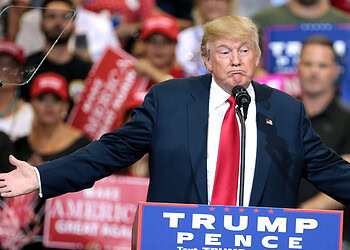
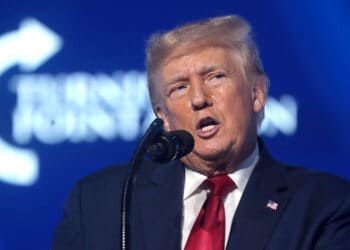
In the new study, the researchers focused on the case of Donald Trump, who tested positive for SARS-CoV-2 and was subsequently hospitalized with COVID-19 symptoms during his presidency. This event provided an opportunity to investigate the relationship between a salient exemplar (Trump) and public attitudes and perceptions of COVID-19.
In two studies, the researchers collected survey data before and after the announcement of Trump’s hospitalization to compare changes in risk perception and hoax beliefs.
In Study 1, the researchers aimed to investigate the association between President Trump’s COVID-19 diagnosis and risk perception among US residents. They collected data through two waves of surveys conducted before and after the announcement of Trump’s diagnosis. The sample consisted of 909 participants in Wave 1 and 447 participants in Wave 2, with a total sample size of 1,356 participants.
The participants completed a six-item COVID-19 risk perception index that measured cognitive, affective, and temporal-spatial dimensions of risk perception. The survey also included socio-demographic variables such as gender, age, self-reported political orientation, and education level.
Political orientation emerged as a significant predictor of risk perception. Participants who identified as more right-leaning on the political spectrum tended to have lower risk perception. Older participants, highly educated participants, and females, on average, expressed higher risk perception.
But the results showed that, after controlling for political orientation and socio-demographic factors, there was no significant association between the wave (pre-announcement vs. post-announcement) and risk perception. This means that Trump’s diagnosis did not have a significant impact on risk perception among the participants. Furthermore, there was no significant interaction between wave and political orientation.
In Study 2, the researchers aimed to investigate whether there was a difference in US residents’ beliefs about the COVID-19 pandemic being a hoax before and after President Trump’s diagnosis, while controlling for demographic factors. They also examined the role of general susceptibility to misinformation in relation to hoax beliefs.
The study recruited participants from the US through an online panel provider. Quota sampling was used to ensure the sample was representative in terms of age and gender. Wave 1 consisted of 949 participants, collected between 24 and 29 September 2020, while Wave 2 included 1,191 participants, collected between 14 and 16 October 2020. The total sample size was 2,140 participants.
Participants were asked to rate the extent to which they believed the COVID-19 pandemic was a hoax on a scale from 1 (definitely not) to 6 (definitely). Demographic variables such as gender, age, self-reported political orientation (ranging from very left-wing/liberal to very right-wing/conservative), and education level were also collected. General susceptibility to misinformation was assessed using the MIST measure, which involved participants rating the truthfulness of 20 news headlines.
In line with Study 1, participants with more conservative/right-wing leanings and higher susceptibility to misinformation tended to have higher hoax beliefs.
The results showed that the wave of recruitment (before or after Trump’s diagnosis) did not have a significant effect on hoax beliefs when considering only wave and demographic factors, as well as when accounting for susceptibility to misinformation. However, a significant interaction between wave and political orientation was observed.
Among left-wing or liberal participants, there was no difference in hoax beliefs between waves. In contrast, among more conservative/right-wing participants, the endorsement of hoax claims was lower for those surveyed after Trump’s announcement compared to before. Further analysis revealed that the effect of wave on hoax beliefs became significant for participants reporting conservative or very conservative political views.
Overall, the studies indicate that President Trump’s diagnosis may have influenced some people to change their views on the virus, but it didn’t affect their perception of its risk.
The researchers said the lack of an effect from Trump’s diagnosis on risk perception may be due to the way he framed his announcement. Despite being infected, Trump projected an image of not being anxious about the disease and being optimistic about his recovery. This framing might have aligned with his previous statements about the virus, leading his followers to believe that the risk of the virus was overestimated.
On the other hand, the findings suggest that participants with right-wing political views may have identified more closely with President Trump, making his diagnosis more influential in shaping their hoax beliefs.
“Indeed, President Trump’s tweet announcing he and his wife had tested positive for COVID-19, were quarantining, and had started their recovery process became Trump’s most retweeted tweet ever. It is conceivable that this tweet—openly and publicly acknowledging his diagnosis after having appeared more sceptical in the past—may have sent a strong ‘elite cue’ to his supporters around the existence of the virus,” the researchers said.
The study, “COVID-19 risk perception and hoax beliefs in the US immediately before and after the announcement of President Trump’s diagnosis“, was authored by Lisa-Maria Tanase, John Kerr, Alexandra L. J. Freeman, and Claudia R. Schneider.