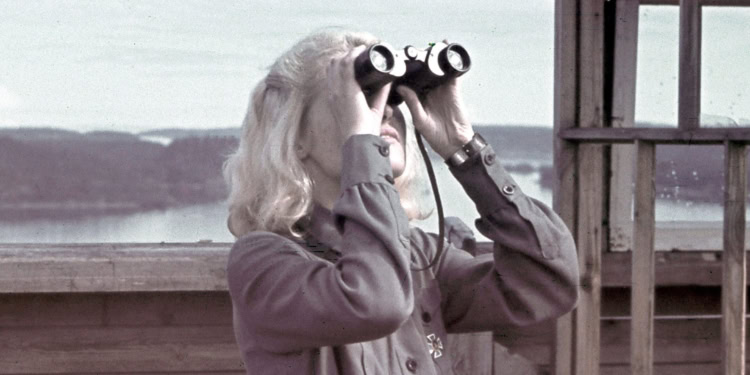

Girls and young women who served in a paramilitary organization during World War II had accelerated reproductive schedules, according to new research published in Nature Communications. The study provides evidence that exposure to stress, trauma, and mortality can alter women’s reproductive decisions.
“I am an evolutionary anthropologist and this question about how humans adaptively respond to conditions experienced during development is central to the field. Of course reproduction is at the center of all of this,” said study author Robert Lynch, a postdoctoral researcher at the University of Turku in Finland.
“So when I learned that we had data on women who were exposed to higher mortality and stress and at such young ages that could help to answer some of these questions, it was naturally of great interest to me.”
For their study, the researchers utilized a unique database from Finland, which gathered data on evacuees during World War II.
The Soviet Union invaded Finland in 1939, marking the beginning of the Winter War, and the Karelian population fled to western Finland, although approximately 60% of these evacuees returned to Karelia when it was temporarily recaptured by Finland between 1942 and 1944. Between 1968 and 1970, more than 300 individuals conducted structured interviews of approximately 250,000 Karelia evacuees.
These interviews included 37,613 women with records on their year of birth, place of birth, occupation, and years of birth of all their children. More than 4,000 of these women were listed as members of the paramilitary Lotta Svärd organization, which was tasked with supporting troops as nurses, air raid spotters, mess personnel and in other auxiliary capacities. These women were between 12 and 40 years old in 1939.
The researchers found that young women who joined Lotta Svärd waited less time to have their first child after the war ended, had shorter interbirth intervals, and higher lifetime reproductive success compared to their female counterparts who didn’t join the paramilitary group.
“An average reader should understand how past evolutionary pressures can influence your own current behavior. In this case evolution may have favored greater discounting (i.e. valuing present over future rewards) when people grow up in a dangerous or unpredictable environment (e.g. high mortality). This behavior can result in major changes to one’s life trajectory such as when and if you marry, have children and how many you end up having,” Lynch told PsyPost.
“These are not trivial effects. If we can measure these effects in basic life history traits then it almost certainly has large effects on many other behaviors we also care about such as overall aversion to risk, sociality or the pace of sexual development.”
The situation in Finland during WWII represented a “natural experiment,” in which two otherwise similar groups of women were divided by one factor — whether or not they joined Lotta Svärd. But despite the quasi-experimental data, the study still include some caveats.
“We do control for many of the issues of selection bias whereby some unknown and unmeasured trait similarly increases both the likelihood of volunteering to serve in this organization and someone’s reproductive timing by using a subset of sisters (one who served and one who did not) and comparing reproductive schedules of the same women both before and after the war,” Lynch explained.
“However, this is not a controlled study with randomized groups. These women are self-selected so the issue of selection bias persists. One of the most important question that still needs to be addressed is how this happens. How does exposure to higher mortality or stress affect reproductive timing. We do not know the proximate causes of the behavioral change which result in accelerated reproductive schedules (e.g. reduced risk aversion or greater discounting).”
The study could also have implications for the modern day.
“This finding and other studies like this may even have implications for the current pandemic. This is pure speculation of course, but if younger children are being exposed to constant media reports of ‘staggering’ death tolls from COVID-19 or possibly even exposed to deaths of their own family members, we might expect evolved behavioral response that could result in faster reproductive schedules for this cohort when they reach adulthood,” Lynch explained.
The study, “Child volunteers in a women’s paramilitary organization in World War II have accelerated reproductive schedules“, was authored by Robert Lynch, Virpi Lummaa, Michael Briga, Simon N. Chapman, and John Loehr.
(Photo credit: SA-kuva Finnish Wartime Photograph Archive)