A new study published in Nature Communications provides evidence that the human brain does not simply shrink with age but changes shape in consistent and measurable ways. The research suggests that these shape changes are closely tied to age-related cognitive decline and may offer a new way to detect dementia risk before symptoms appear.
Most research on brain aging has emphasized the loss of volume in specific regions, like the hippocampus, which plays a key role in memory. These studies have revealed that certain brain areas are more vulnerable to aging than others, showing pronounced shrinkage as people get older. However, the brain is not made up of isolated parts. Its regions are connected and interact in complex ways. The new study focused on these broader patterns, aiming to understand how aging affects the geometry of the entire brain rather than just the size of individual pieces.
The research was motivated by growing evidence that the brain’s shape affects how it functions. Studies have shown that the brain’s physical structure can place constraints on how different regions communicate. Subtle shifts in position, shape, or spacing between regions might disrupt the brain’s internal coordination. Despite this possibility, previous methods typically did not examine the geometry of the brain’s spatial layout. This study set out to fill that gap.
“It’s well known that the brain changes as we age, but most research has focused on individual regions, like the hippocampus, that are known to shrink over time,” said study author Niels Janssen, an assistant professor of psychology at Universidad de La Laguna in Spain. “In our study, we looked instead at how aging affects the shape of the whole brain. We found that the brain doesn’t just get smaller—it sags, almost as if it’s slowly settling under its own weight. The lower parts of the hemispheres spread outward, while the upper parts draw together, producing a gentle downward slouch in the brain’s overall shape.”
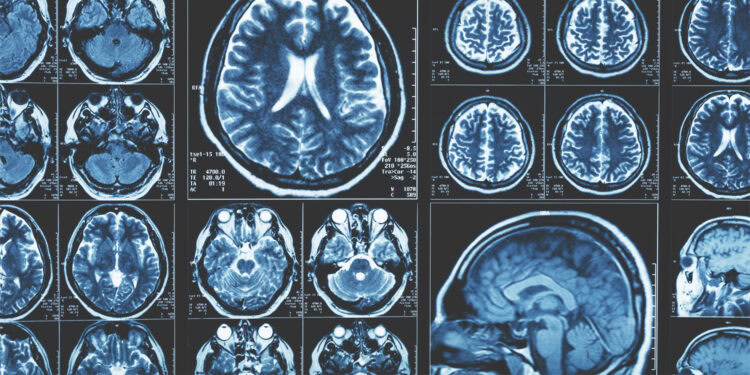
The research team analyzed more than 2,600 brain scans from adults between the ages of 30 and 97. The research team analyzed 2,603 brain scans from adults between the ages of 30 and 97. These scans came from two large and independent datasets: the primary analysis used 2,039 scans from the Open Access Series of Imaging Studies, and the findings were then confirmed in a separate set of 564 scans from the Cambridge Centre for Ageing and Neuroscience. All participants had undergone high-resolution magnetic resonance imaging, allowing the researchers to observe fine-grained structural features.
To measure changes in the brain’s shape, the team used a method that calculates the distance between points on the brain’s surface and across matching regions in the left and right hemispheres. For example, they assessed how far apart the left and right hippocampus were, and whether that distance changed with age. This approach allowed the researchers to identify patterns of “expansion,” where regions appeared to move farther apart, and “compression,” where they shifted closer together.
They found a consistent pattern across the samples. As people aged, the lower front parts of the brain tended to move outward, creating a subtle bulging effect. At the same time, the upper back parts of the brain drew inward. This produced a sloping or sagging effect, almost like the brain was slowly settling downward. These patterns became more pronounced with increasing age.
In addition to looking at overall shape, the study examined how the distances between paired brain regions across hemispheres changed over time. Many of these distances, especially between temporal and subcortical areas, increased with age. These shifts were not merely byproducts of brain shrinkage. Even after accounting for changes in volume, the spatial shifts remained significant.
The study also linked these shape changes to cognitive performance. Participants who performed worse on memory and executive function tests tended to show more extreme patterns of expansion and compression. For example, individuals with poorer memory showed greater separation between parts of the temporal lobe and more compression in parietal regions. These associations were found even after accounting for age, suggesting that shape changes might track with cognitive function more closely than age alone.
“Understanding how the brain ages is a complex challenge that requires looking at it from many angles,” Janssen told PsyPost. “Most studies focus on the microscopic level—on molecules and cells—but our findings show that the shape of the brain itself also changes in meaningful ways. Viewing the brain at this larger scale may provide new insights into the mechanisms of healthy aging and the changes that occur in neurodegenerative diseases such as Alzheimer’s.”
Although the findings are consistent and supported by two independent datasets, there are several limitations. One is that most of the data came from cross-sectional samples, meaning different people were compared at different ages. This makes it difficult to track how an individual’s brain changes over time. The study did include a smaller group of participants scanned more than once, and their results supported the larger trends. Still, more long-term studies are needed to confirm these patterns.
Another limitation is that the method used in the study measures distances between points in space, but not the biological mechanisms driving these changes. For example, it remains unclear whether the observed expansion and compression are due to changes in tissue composition, fluid balance, or other factors such as gravity and head positioning.
Future research may investigate whether mechanical stress, such as gradual downward shifting of the brain, contributes to age-related damage. This could open new pathways for understanding how structural changes lead to functional decline. It may also be possible to develop early warning systems based on the shape of the brain, identifying those most at risk for cognitive impairment before symptoms appear.
Despite these limitations, the study presents a new way of thinking about brain aging. It suggests that how the brain is shaped may matter just as much as how much brain tissue is lost. Subtle shifts in geometry may affect how different parts of the brain communicate and how efficiently they work together. Some regions, like the entorhinal cortex, sit close to hard structures like the base of the skull and might be particularly vulnerable to pressure from surrounding tissue.
“This could help explain why the entorhinal cortex is ground zero of Alzheimer’s pathology,” said study co-author Michael Yassa, the director of the University of California, Irvine’s Center for the Neurobiology of Learning and Memory and James L. McGaugh Endowed Chair. “If the aging brain is gradually shifting in a way that squeezes this fragile region against a rigid boundary, it may create the perfect storm for damage to take root. Understanding that process gives us a whole new way to think about the mechanisms of Alzheimer’s disease and the possibility of early detection.”
“We’re just beginning to unlock how brain geometry shapes disease. But this research shows that the answers may be hiding in plain sight – in the shape of the brain itself.”
The study, “Age-related constraints on the spatial geometry of the brain,” was authored by Yuritza Y. Escalante, Jenna N. Adams, Michael A. Yassa, and Niels Janssen.