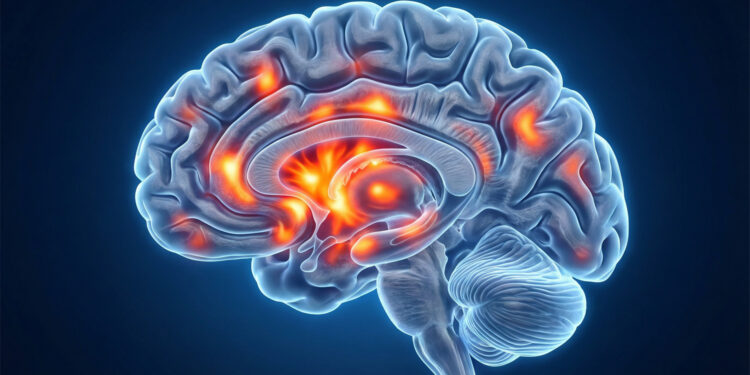

For most young children, the sight and voice of a parent serve as a primary source of comfort and safety. A new study suggests that for children who have experienced interpersonal violence or abuse, the brain processes these caregiver signals in a distinct way. Researchers found that a history of threat experiences is linked to heightened activity in the insula, a brain region involved in sensing the body’s internal state and determining what is important in the environment. These findings, published in the journal Developmental Science, offer new insight into how early adversity may shape the developing brain.
Scientists have spent decades trying to understand how difficult childhoods influence biological development. One prevailing theory is the Dimensional Model of Adversity and Psychopathology. This framework suggests that different types of bad experiences affect the brain in specific ways.
The model distinguishes between two main categories of adversity: threat and deprivation. Threat involves the presence of harm, such as physical abuse or exposure to domestic violence. Deprivation involves the absence of expected inputs, such as neglect or a lack of cognitive stimulation.
Researchers hypothesized that threat and deprivation would trigger different biological mechanisms. This theory draws heavy inspiration from animal research. Studies on rodents have shown that when rat pups experience rough handling by their mothers, their brain activity shifts.
In these animal models, pups exposed to rough care process maternal cues aberrantly. Instead of the mother’s presence calming the pup’s fear circuitry, it can increase activity in areas of the brain associated with threat detection. The human equivalent of this phenomenon has been difficult to isolate until recently.
Nicolas Murgueitio, a researcher affiliated with the University of North Carolina at Chapel Hill and Emory University School of Medicine, led the investigation. He worked alongside a team of psychologists and neuroscientists from institutions including Harvard University and New York University. The team aimed to test if the specific effects of threat observed in rodents would appear in human children.
The researchers recruited 148 children between the ages of four and nine for the study. This age range is significant because it represents a period of high plasticity in brain development. It is also a time when children are heavily dependent on their caregivers for emotional regulation.
To understand the children’s backgrounds, the team used a comprehensive set of interviews and questionnaires. They collected data from both the children and their guardians. This allowed them to create detailed scores for each child regarding their exposure to threat and deprivation.
Threat scores included experiences like physical abuse, sexual abuse, and witnessing domestic violence. Deprivation scores accounted for physical neglect, lack of educational materials in the home, and limited parental involvement in learning. This detailed accounting allowed the scientists to separate the effects of violence from the effects of neglect.
The core of the study involved observing the children’s brains in action using functional magnetic resonance imaging, or fMRI. This technology measures brain activity by detecting changes in blood flow. While inside the scanner, the children completed a task designed to engage their emotions and attention.
The researchers used a “multimodal” stimulus, meaning it engaged both sight and hearing. Children saw a picture of their primary caregiver and heard a recording of that caregiver’s voice. The voice provided a “scaffold,” or a helpful prompt, such as telling the child they were about to see pictures of kids playing.
For comparison, the children also saw pictures and heard recordings of a stranger. These strangers were matched to the caregivers in terms of sex, race, and age. This comparison allowed the researchers to isolate the brain’s specific response to the parent, rather than just its response to any adult face or voice.
When the researchers analyzed the brain scans of the entire group, they found widespread activity in response to caregivers. Areas of the brain associated with visual processing and social cognition lit up more for parents than for strangers. This indicates that, generally, a parent is a highly engaging social signal for a child.
The team then looked for specific patterns linked to the children’s adversity scores. They found that a history of deprivation was not associated with differences in how the brain responded to the caregiver. The level of neglect a child experienced did not predict changes in neural activation during this specific task.
However, the results for threat experiences were different. Children with higher levels of threat exposure showed significantly greater activation in the insula when processing their caregiver’s cues. This effect remained even when the researchers controlled for levels of deprivation.
The insula is a complex region of the brain deep within the cerebral cortex. It plays a key role in “interoception,” which is the sense of the physiological condition of the body. It helps an individual feel their own heartbeat or gut feelings.
Beyond monitoring the body, the insula is central to the “salience network.” This network helps the brain decide what is most important in the immediate environment. It acts as a filter, highlighting things that deserve immediate attention and mental resources.
The increased insula activity suggests that for children exposed to violence, the caregiver is a highly salient stimulus. The researchers interpret this as a sign that the brain is allocating extra resources to process the caregiver’s presence. In a safe environment, a parent is a source of predictability.
In an environment characterized by threat, a parent may be a source of both care and danger. This duality can make the caregiver a confusing or unpredictable signal. The insula may be working harder to predict what the caregiver will do next or to prepare the body for a potential reaction.
The researchers had originally hypothesized that they would see differences in the amygdala. The amygdala is a small, almond-shaped structure often referred to as the brain’s fear center. Previous studies on institutionalized children had suggested that adversity blunts the amygdala’s response to parents.
In this study, however, threat exposure did not correlate with changes in amygdala activation. The authors suggest this might be due to the nature of the task. The children were listening to a helpful, regulating voice rather than just looking at a static face.
This multimodal approach creates a more complex social experience than simple picture-viewing tasks. It may be that the addition of the voice and the “scaffolding” context engages the brain’s salience network more than its basic threat detection centers. The findings align with the idea that the brain adapts to its environment in specific, functional ways.
There are several caveats to consider when interpreting these results. The study was cross-sectional, meaning it looked at the children at a single point in time. It cannot definitively prove that the threat experiences caused the brain differences, only that they are related.
The age range of the participants also presents a variable. A four-year-old relies on a parent differently than a nine-year-old does. While the researchers controlled for age in their statistical models, developmental changes across this span are rapid and substantial.
Another limitation lies in the comparison between a caregiver and a stranger. The caregiver is a familiar person, while the stranger is novel. It is possible that the brain differences reflect how traumatized children process familiarity versus novelty, rather than the caregiver specifically.
The researchers also note that their sample was relatively low-risk compared to populations in the foster care system or institutional settings. The children had lower levels of deprivation on average. This might explain why deprivation did not show a strong link to brain activity in this specific group.
Future research will need to explore the long-term consequences of this heightened insula activity. It remains to be seen whether this neural pattern predicts later mental health issues, such as anxiety or depression. Understanding the behavioral outcomes of these brain differences is a necessary next step.
The team suggests that future studies should look at how these brain responses relate to attachment styles. Disorganized attachment, where a child seeks comfort from a parent but also appears frightened of them, might be the behavioral behavior counterpart to these neural findings. Connecting the biology to the behavior could inform better interventions.
This study provides evidence that not all childhood adversity impacts the brain in the same way. The distinction between threat and deprivation appears to be biologically real. Violence and abuse may uniquely alter the neural circuitry involved in processing the people closest to us.
By identifying the insula as a key player, this research opens new avenues for understanding the impact of trauma. It suggests that for some children, the mere presence of a parent triggers a heightened state of internal monitoring and attention. Recognizing this burden on the developing brain is the first step toward helping these children heal.
The study, “Neural Responses to Caregivers After Early Life Threat Experiences,” was authored by Nicolas Murgueitio, Michelle Shipkova, Lucy A. Lurie, Micaela Rodriguez, Laura Machlin, Maresa Tate, Sneha Boda, Zoe Priddy, Cathi B. Propper, Katie A. McLaughlin, Regina M. Sullivan, and Margaret A. Sheridan.