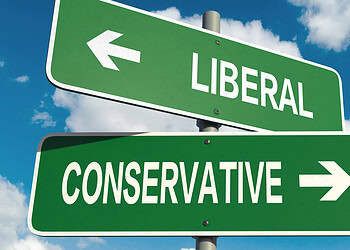
Political conservatives in the United States see scientific evidence and personal experience as closer in legitimacy than liberals, according to new research published in the journal Political Psychology. The findings provide evidence that conservatives and liberals tend to evaluate sources of knowledge differently, even in regard to non-political issues.
“Understanding how and why people differ in how they figure out what’s real and what’s not, and why there seems to be a divide there based on political ideology, is in my mind the major question of our time as far as social scientists are concerned,” said study author Randy B. Stein, an assistant professor of marketing at Cal Poly Pomona.
“One of the inspirations for the research was the tendency for conservative news outlets to want to represent ‘both sides’ of climate science (meaning, the actual science and the deniers) as equally legitimate. That’s one of the things that lead some social scientists to suggest that conservatives are more anti-science or anti-empiricism than liberals.”
“But there’s always been a competing view that maybe both liberals and conservatives are just making the most convenient arguments for them — e.g., conservatives don’t like climate science not because they’re anti-science per se, but because they don’t like the implications of climate science in general.”
In two studies, which included 913 individuals in total, participants were asked to read an article in which a scientist was quoted as debunking a popular misconception. The article also included a quote from a second person who rejected the views of the scientist in favor of personal experience.
The articles were not political in nature. “We asked participants to rate the legitimacy of researchers and people providing anecdotal evidence for topics like whether luck exists in games of chance, whether a personality test is accurate, whether fund managers can beat the market — topics that aren’t politicized but also where the science is pretty clear (and for luck, it’s by definition),” Stein explained.
The researchers found that both conservatives and liberals evaluated the researcher as having a more valid and credible opinion than the second person. However, conservative participants tended to evaluate the second person more favorably and the scientist less favorably than liberal participants.
“The major takeaway is that conservatives, compared to liberals, are more likely to see empirical (e.g., scientific) and experiential (e.g., anecdotal) perspectives as more equal in legitimacy,” Stein told PsyPost.
“Liberals think empirical evidence is better at approximating reality, conservatives are more likely to say that both research and anecdotes are legitimate. The trends are on average — it doesn’t mean there are no anti-science liberals or pro-science conservatives. And it doesn’t mean conservatives are biased and liberals aren’t – surely everyone is biased towards wanting their most convenient version of the world to be true, what we’re showing is ideological differences in how truth is approximated.”
The researchers also found that the difference between conservatives and liberals was mediated by thinking styles. Conservatives were more likely to exhibit an intuitive thinking style, agreeing with statements such as “People know, deep down, what’s true and what’s not.”
But there are some other possible explanations for the findings.
“One interpretation of our results is maybe conservatives just don’t trust the researchers themselves, as in maybe they think all scientists are corrupt, even if they are researching topics that have nothing to do with ideology,” Stein explained. “That’s possible, but at some point the line between judging the science and judging the scientists will become paper thin — I don’t think there’s much practical difference between ‘I distrust science’ and ‘I might trust science in general, but I distrust the people who practice it.'”
“When we ran these studies in 2018, I was unsure about what results we’d find – why would conservatives resist science about whether a personality test is accurate?” Stein added. “In January 2021, after a year of ‘debates’ about the science of COVID-19 and conservative anti-maskers and sympathy towards conspiracy theories (COVID-19, the election, QAnon), now I just kind of feel like we’re documenting and describing what’s going on.”
The study, “Hearing From Both Sides: Differences Between Liberal and Conservative Attitudes Toward Scientific and Experiential Evidence“, was authored by Randy Stein, Alexander B. Swan, and Michelle Sarraf.