![[Adobe Stock]](https://sp-ao.shortpixel.ai/client/to_webp,q_glossy,ret_img,w_750,h_375/https://www.psypost.org/wp-content/uploads/2025/05/neurons-1-750x375.jpg)
New research offers a rare glimpse into how popular weight-loss medications affect electrical activity deep within the human brain. A case study involving a patient with obesity and binge-eating disorder suggests that the drug tirzepatide may suppress specific brain signals linked to food cravings. The findings also indicate that this neurological suppression might be temporary for some individuals. The study, which details these direct neural recordings, was published in Nature Medicine.
Many individuals with obesity struggle with a phenomenon often described as food noise. This term refers to constant, intrusive thoughts about food that can make adhering to a diet exceptionally difficult. These obsessive thoughts often precede episodes of loss-of-control eating. Such behaviors are driven by the brain’s reward circuitry rather than simple hunger.
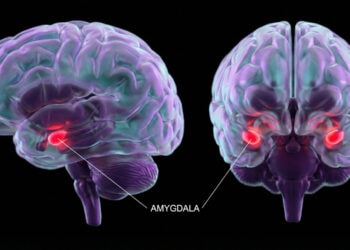
The nucleus accumbens is a small structure deep in the brain that plays a central role in this circuitry. It helps regulate motivation, pleasure, and impulse control. When this region becomes dysregulated, it can contribute to the impulsive behaviors seen in severe eating disorders. Scientists have suspected that weight-loss drugs might interact with this region to reduce cravings.
Researchers at the University of Pennsylvania sought to measure this interaction directly. They utilized a technology known as responsive neurostimulation to monitor brain activity in real time. This approach is typically used to treat conditions like epilepsy or Parkinson’s disease.
The study involved patients who suffered from treatment-resistant obesity and loss-of-control eating. These individuals had not found relief through gastric bypass surgery, behavioral therapy, or standard medications. To help them, surgeons implanted electrodes directly into the nucleus accumbens of their brains. These electrodes were connected to a device capable of recording electrical impulses.
The researchers first established a baseline for what food cravings look like in the brain. They analyzed data from two participants who were not taking tirzepatide. These participants recorded their feelings of hunger and craving throughout the day. They swiped a magnet over their implant to mark moments of severe food preoccupation.
A distinct pattern emerged in the electrical data from these two participants. During moments of intense food noise, the electrodes detected a specific low-frequency oscillation. This electrical wave occurred in the delta-theta frequency band. This signal served as a reliable biomarker for the state of high food preoccupation.
The study then focused on a third patient, referred to as Participant 3. This 60-year-old woman had a history of severe obesity and type 2 diabetes. She had previously struggled with frequent episodes of binge eating. Unlike the first two participants, she was prescribed tirzepatide to manage her diabetes.
Tirzepatide mimics the action of two natural hormones involved in blood sugar and appetite regulation. These hormones are glucagon-like peptide-1 (GLP-1) and glucose-dependent insulinotropic polypeptide (GIP). The patient increased her dosage to the maximum therapeutic level around the time of her electrode implantation. This timing provided the researchers with a unique experimental setup.
For the first few months following her surgery, Participant 3 reported a dramatic change in her symptoms. She experienced almost no food noise or cravings. She described feeling in control of her eating choices for the first time in years. The recordings from her brain implant mirrored this subjective report.
During this symptom-free period, the low-frequency electrical signal seen in the other participants was absent. The specific biomarker associated with food preoccupation had flattened out. The activity in her nucleus accumbens looked indistinguishable from brain activity during periods of relaxation. This suggested that the medication was effectively dampening the neural firing associated with cravings.
The situation shifted after approximately five months of treatment. Participant 3 began to report that her intrusive thoughts about food were returning. She experienced “breakthrough” episodes of food preoccupation despite remaining on the maximum dose of the drug. The silence in her mind was being replaced by the familiar noise of cravings.
The researchers analyzed the brain recordings from this later period. They found that the low-frequency delta-theta signal had reemerged. As the patient’s food noise returned, so did the electrical signature associated with it. The return of the neural signal correlated strongly with her self-reported lapses in dietary control.
This observation suggests that the brain might develop a form of tolerance to the drug’s neurological effects. The medication initially succeeded in quieting the reward circuitry. Over time, however, the circuitry appeared to adapt or reset. The suppression of the craving-related signal was not permanent in this case.
The study provides direct physiological evidence of how incretin-based therapies engage the human brain. It confirms that these drugs can modulate activity in the reward center. It also highlights the potential for neural adaptation that may limit their long-term effectiveness for some behavioral symptoms.
The findings offer a potential explanation for why some patients see their weight loss plateau. It may also explain why cravings can return even while patients continue medication. Understanding this mechanism is a step toward managing long-term treatment expectations.
Senior author Casey H. Halpern noted the significance of these observations in a press statement. “This study offers major insights into how these drugs may work inside the brain and will guide us as we explore new indications,” Halpern said. He emphasized the need for caution regarding the drugs’ capabilities. “Until we better understand their action on the brain, it’s far too soon to call GLP-1 and GIP inhibitors miracle drugs for more conditions beyond type 2 diabetes and obesity.”
The use of intracranial electroencephalography provided a level of detail not possible with external scans. Standard brain imaging cannot easily track rapid changes in electrical oscillations. The implanted device allowed for continuous monitoring in a natural setting.
This method opens new avenues for precision medicine in psychiatry and metabolic health. Scientists could potentially use these neural biomarkers to track how well a medication is working. This would allow doctors to adjust treatments based on objective brain data rather than just patient reports.
There are several limitations to this study that must be considered. The results regarding tirzepatide come from a single case study. It is not yet known if this pattern of suppression and recurrence occurs in all patients. Individual brain chemistry varies significantly from person to person.
Simon Cork, a senior lecturer in Physiology at Anglia Ruskin University who was not involved in the study, commented on the need for context when interpreting these results. He told the Science Media Centre that the study focused on a specific subset of patients rather than the general population. “This study specifically looked at a marker of brain activity associated with periods of ‘binge eating’ in patients with obesity associated with food preoccupation,” Cork said.
Cork added that “this is a specific (and rare) condition associated with obesity.” Consequently, the neural patterns observed here might not be universal. The distinction is important for managing public expectations about these medications. “So, while this study is methodologically very interesting, it has to be clear that this is only one patient with a very specific condition that is associated with obesity and so shouldn’t necessarily be generalised to the entire population,” Cork said.
Additionally, the study cannot definitively prove that the drug caused the initial silence in brain activity. Other factors related to the surgery or postoperative recovery could have played a role. However, the strong correlation between the drug dose, the symptoms, and the electrical signals is notable.
The distinction between homeostatic and hedonic eating is also relevant here. Homeostatic eating is driven by energy needs, while hedonic eating is driven by pleasure. This study suggests that these drugs impact the hedonic pathways located in the nucleus accumbens.
The researchers did not stimulate the brain to stop the cravings in this phase of the study. They only recorded the activity to understand the natural progression. Future trials may involve using the device to deliver electrical stimulation when the craving signal is detected.
This “closed-loop” approach could theoretically bolster the effects of the medication. If the drug’s ability to suppress the signal fades, electrical stimulation could step in. This would create a hybrid therapy combining pharmacology and technology.
Co-first author Wonkyung Choi commented on the value of the data despite the small sample size. “Although this study only featured the data from one person taking tirzepatide, it provides compelling data about how GLP-1 and GIP inhibitors alter electrical signals in the brain,” Choi said.
The research team plans to continue investigating how these therapies influence brain dynamics. They hope to identify which specific receptors are responsible for the change in neural activity. This could lead to the development of more targeted medications with longer-lasting effects on food noise.
The study represents a convergence of metabolic medicine and neuroscience. It treats obesity not just as a hormonal issue but as a neurological one. By mapping the neural signatures of craving, scientists are getting closer to the root of dysregulated eating.
For now, the findings serve as both a promise and a precaution. They confirm that weight-loss drugs can profoundly alter brain activity related to cravings. Yet they also warn that the brain is a dynamic organ capable of resisting even powerful pharmaceutical interventions.
Further research will be needed to generalize these findings to a broader population. Large-scale studies using non-invasive methods could help validate the delta-theta biomarker. If confirmed, this neural signature could become a standard tool for assessing eating disorders.
The study, “Brain activity associated with breakthrough food preoccupation in an individual on tirzepatide,” was authored by Wonkyung Choi, Young-Hoon Nho, Liming Qiu, Andrew Chang, Gustavo Campos, Robert L. Seilheimer, W. Bryan Wilent, David Bakalov, Nida Firdous, Marie Kerr, Disha Joshi, Gabriella Maze, Uros Topalovic, Daniel Batista, Nanthia Suthana, Anastassia Amaro, Matthew R. Hayes, Iahn Cajigas, Mario Cristancho, Kelly C. Allison, Bijan Pesaran, Katherine W. Scangos, Joshua I. Gold, Thomas A. Wadden, and Casey H. Halpern.