

Depressed people are more likely to enjoy internet memes that contain themes related to sadness, hopelessness or isolation — and they also show an attentional bias towards these images, according to new research.
“My co-author Jennifer Drabble and I often use memes as a way to communicate. Indeed, for years my social media feed would be filled with memes shared by friends, often related to mental health,” said Umair Akram (@Eumayrs), the lead author of the new studies and a lecturer at Sheffield Hallam University.
“As someone who suffers from depression, I personally found memes related to depression quite funny and relatable, despite the dark and negative content. It seemed that my friends felt the same way. Considering this, we wanted to determine whether we could scientifically examine the perception of depressive memes.”
In a study published in Scientific Reports, the researchers surveyed 43 individuals with clinically significant depressive symptoms and 56 non-depressed controls. The participants were shown a series of depression-related memes and neutral memes, and rated each on a five-point scale for humor, relatability, shareability, and mood-improving potential.

Compared to the non-depressed group, Akram and his colleagues found the depressed group tended to rate depression-related memes as more relatable and funnier. “Those experiencing symptoms of depression find depressive memes to be quite funny, relatable, something they would share and interestingly — something that they thought might benefit others with the same symptoms,” he explained. The findings also indicated “that those with deficits in emotion regulation strategies were more likely to prefer depressive memes.”
But the researchers also “wanted to objectively explore how this population observe depressive (relative to general) memes,” Akram said “As such, we had subjects come into the lab and recorded their eye movements and gaze behavior whilst they observed a series of memes.”
In their next study, published in Experimental Brain Research, 9 individuals with clinically significant depressive symptoms and 12 non-depressed controls again viewed memes. But this time, the humorous images were part of a visual attention task.
The participants were first asked to fixate their gaze on a cross in the middle of a computer screen. They were then presented with a depression-related meme that was paired next to a neutral meme. This procedure was completed 32 times, using 16 neutral and 16 depressive memes. (Each meme was shown twice.)
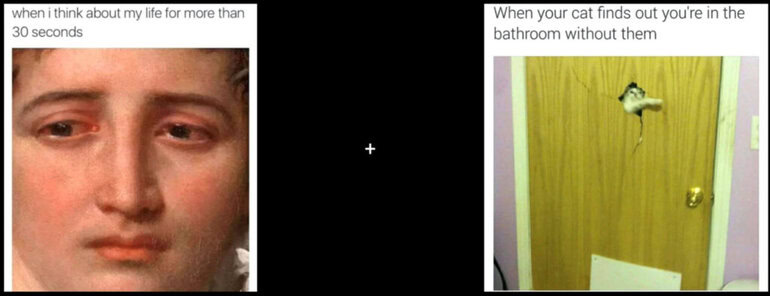
Data from an eye-tracking device revealed that depressed individuals were quicker to orient their gaze towards the depression-related memes and spent more time looking at depressive rather than neutral memes.
“It seems that the attention of individuals with depressive symptoms is more easily captured by memes related to depression. It also seems that this group are less interested in generally humorous memes unrelated to the depression experience,” Akram told PsyPost.
The researchers now hope to replicate these findings in a larger sample. “It would also be interesting to determine how people interact with depressive memes in a more naturalistic setting — for example, whilst scrolling through social media,” Akram said.
In another study that is undergoing peer-review prior to publication, Akram and his colleagues examined whether different humor styles influenced how depressed individuals interpreted memes. “We found that self-defeating humor influenced the extent to which depressed individuals might prefer depressive memes,” he explained.
“The online communities where depressive (and other memes related to mental health difficulties) are very large, and ever increasing,” he researcher added. “People put allot of time and effort into creating these memes, which are almost always fresh, topical and current. In the future, we would like to determine just how exactly depressive memes might serve as a coping mechanism, and whether they can be used in a way that might help people who suffer from depression.”
“It is also relevant to note that, this work is at a very early stage, and may be considered somewhat controversial to those who can’t understand the relevance of depressive memes from the perspective of someone with depression. They might argue that depressive memes may have adverse effects or even promote behavior which may have adverse consequences. Despite this perception, previous studies have determined that memes do not promote such behavior. Either way, more research is certainly required,” Akram concluded.
The study, “Exploratory study on the role of emotion regulation in perceived valence, humour, and beneficial use of depressive internet memes in depression“, was authored by Umair Akram, Jennifer Drabble, Glhenda Cau, Frayer Hershaw, Ashileen Rajenthran, Mollie Lowe, Carissa Trommelen, and Jason G. Ellis.
The study, “Eye tracking and attentional bias for depressive internet memes in depression“, was authored by Umair Akram, Jason G. Ellis, Glhenda Cau, Frayer Hershaw, Ashlieen Rajenthran, Mollie Lowe, Carissa Trommelen, and Jennifer Drabble.