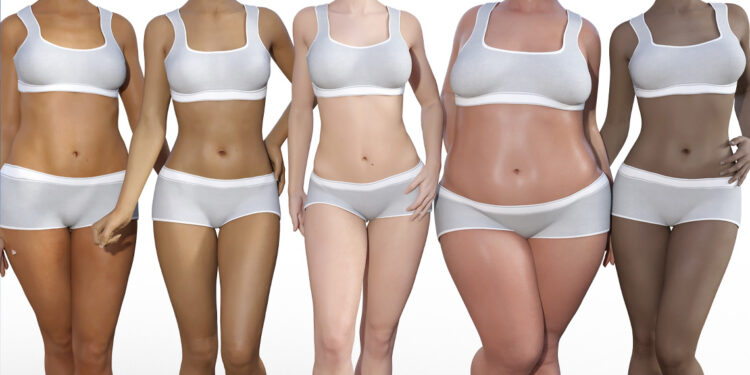

Research published in Personality and Individual Differences revealed that the evolutionary theory suggesting heterosexual men may be attracted to physical aspects of women because they indicate fertility may be flawed.
The new study found that when men are asked to choose body types they find attractive and those they find healthy and fertile, these body types are not the same. This research challenges past evolutionary theories and suggests environmental factors may influence what female body types heterosexual men find attractive.
The theory of sexual selection suggests that both genders are drawn to physical characteristics that are perceived to enhance their likelihood of reproduction. Physical features such as BMI (body mass index), waist-to-hip ratio, waist-to-stature ratio, lumbar curvature, and leg length are all factors that contribute to a woman’s physical appeal. Of these, BMI is considered a significant determinant of attractiveness, with relatively lower values being more desirable in women.
Lower BMI may be perceived as advantageous as it signifies better health, fertility, youthfulness, and maternal investment. Earlier research has found that the most desired BMIs are approximately 18-20, considerably below the average or typical values of young women in well-fed populations.
The healthy BMI range falls between 18.5 and 24.99, while BMI values below 18.5 are categorized as underweight, and those above 25 are classified as overweight. Research indicates that overweight individuals are at a higher risk of developing cardiovascular diseases and some cancers, while a normal BMI is associated with a longer life expectancy.
But research on subsistence and forager communities has revealed that these cultures prefer individuals with a higher BMI. In particular, women with higher BMIs are considered more attractive, especially in areas where food is scarce.
The inclination towards a higher BMI among subsistence populations indicates that environmental elements impact the correlation between BMI and appeal. Additionally, the adverse correlation between BMI and mortality uncovered in subsistence populations contradicts the belief that a lower BMI consistently equates to superior health.
For their new study, Chengyang Han and colleagues sought to explore how women’s body weight can affect men’s perception of their health and fertility and how age can influence men’s preference for body weight. The research employed 3D models of female bodies with different BMI and body fat levels to examine men’s preference for women’s bodies.
The study involved 75 Chinese men who identified as heterosexual, 35 of them being older adults aged between 60 to 82 years old and 40 young adults aged between 19 and 36 years old. The participants were required to rate the attractiveness, perceived health, and perceived fertility of the female body stimuli.
The findings revealed that men preferred women’s bodies with lower BMI and body fat levels for attractiveness compared to those considered healthy and fertile. Additionally, younger men preferred women’s bodies with lower BMI and body fat levels than older men.
This indicates that the commonly accepted belief linking health and fertility with BMI among women may need to be revised. Women with lower BMIs were perceived as more attractive, while a higher BMI was necessary to be perceived as healthier. The most fertile female body was also connected with an even higher BMI.
The research team acknowledged some limitations to the study. First, a 3D representation of the human body used to assess male perceptions of female body attractiveness and fertility may only partially capture the diversity of body shapes across different BMI and body fat levels. Second, the results are based on modern industrial society, and conducting more tests on people from varied cultures and backgrounds would help to determine cross-cultural consistency.
Han and colleagues found no evidence to support the theory that a woman’s attractiveness, perceived health, and perceived fertility are linked to her BMI and body fat. Surprisingly, the study revealed that women with low BMI and body fat, considered the most attractive, were not necessarily perceived as the healthiest and most fertile. These findings are consistent with epidemiological data, indicating that men’s preference for low BMI and body fat in female bodies may be attributed to other factors.
They study, “The picky men: Men’s preference for women’s body differed among attractiveness, health, and fertility conditions“, was authored by Chengyang Han, Xiangqian Li, Shuai Wang, Ranran Hong, Jiajia Ji, Jixu Chen, Haoliang Zhu, Edward R. Morrison, Xue Lei.