People who trust humans do not necessarily tend to also trust products that have artificial intelligence (like Siri or robots), according to new research published in Personality Neuroscience. The study also found no evidence that trust in humans and trust in AI involved the same parts of the brain.
“More and more products are on the markets, where AI is in-built. Products include smartphones, self-driving cars, robots and recently also AI-products such as ChatGPT. I think it is crucial to understand how people develop trust towards products with AI and this was the starting point for our study,” said study author Christian Montag, a psychology professor at Ulm University and author of “Animal Emotions: How They Drive Human Behavior”
The study included 90 male participants with no history of mental or brain problems. The participants completed questionnaires regarding how much they trust humans, their acceptance and fear of AI, and how much they trust different products with AI, such as self-driving cars and human-like robots.
To measure how much they trust humans, they answered eight questions about whether they agree or disagree with certain statements from the NEO Personality Inventory-Revised (NEO-PI-R). For example, “I generally trust people.” They answered on a scale from “strongly disagree” to “strongly agree.”
To measure their general attitudes toward AI, they answered questions from a questionnaire called the Attitude Toward Artificial Intelligence scale. The measure includes items such as “I fear artificial intelligence” and “Artificial intelligence will benefit humankind.”
To measure how much they trust different products with AI, the participants were asked questions about whether they would be willing to use them and how much they trust them. They were asked about Google’s self-driving car, Apple’s Siri, the Chinese Alexa (Amazon), the social robot Pepper, and four human-like android products (Erica, Geminoid HI-1, Sophia, and Geminoid DK).
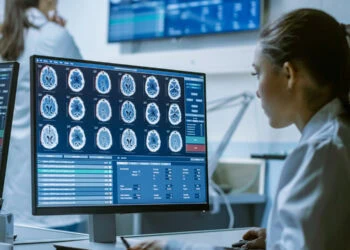
The participants underwent MRI scans to assess their brain structure. To analyze the data, the researchers used a technique called source-based morphometry (SBM), which is a way of looking for patterns in the brain structure data without making assumptions about which parts of the brain are important.
Because there haven’t been many studies on this topic before, the researchers wanted to separate people’s general trust in AI from their specific trust in different products with AI. They also wanted to see if trusting humans and trusting AI were related to similar areas of the brain.
The researchers found that trust ratings for different AI products were closely related to each other, and a combined score of trust for AI products was also related to general attitudes toward AI.
But how much people trust other humans, as measured by the NEO-PI-R questionnaire, was not related to how much they trust AI products. Overall, there was no significant correlation between trust in AI and trust in humans, which suggests that these are two different areas of trust that are not related.
“Whereas trust in other humans facilitates cooperation and exchange in social groups and may represent an evolutionary evolved survival advantage, exposure to and experiences with AI represent a very recent phenomenon,” the researchers wrote in their study.
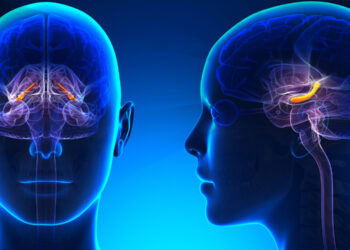
In addition, Montag and his colleagues found that there was no significant association between individual variations in brain structure and trust in AI. However, when looking at trust in humans, the study found a negative association with a component of brain structure that includes regions like the bilateral thalamic-striatal regions and the right middle frontal cortex. This means that trust in humans is associated with brain structure, but there was no corresponding significant association found for trust in AI.
“We observed that trusting in humans and trusting products with AI is not associated with each other. Hence, these psychological constructs seem to be very different topics. This was further underlined by our brain imaging findings, where we observed a link between brain structure and trusting humans, but not a comparable strong brain structure link for trusting AI,” Montag told PsyPost.
“It is important to note that our findings are preliminary, because research in this area is scant. Further, we need to see if the findings can be transferred to other study populations. Hence, our findings will need to be revisited.”
The study, “Trust toward humans and trust toward artificial intelligence are not associated: Initial insights from self-report and neurostructural brain imaging“, was authored by Christian Montag, Benjamin Klugah-Brown, Xinqi Zhou, Jennifer Wernicke, Congcong Liu, Juan Kou, Yuanshu Chen, Brian W. Haas and Benjamin Becker.