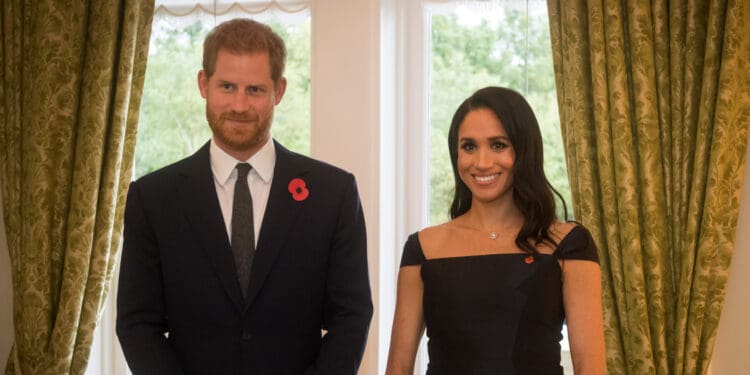
Recent research has revealed how attitudes toward interracial romantic relationships are influenced by societal norms and personal anxieties. Conducted during key moments in the life of a famous interracial couple, Prince Harry and Meghan Markle, the study offers fresh insights into how people perceive and react to interracial unions. The research has been published in the Journal of Applied Social Psychology.
Historically, interracial relationships have faced societal resistance, often clouded by stereotypes and prejudices. Past research has shown that these relationships are less likely to receive social support and more likely to be viewed through a lens of skepticism and negativity. Against this backdrop, the researchers aimed to explore the dynamics of interracial relationships in the context of modern society, where such unions, though still rare, are gradually increasing.
“My work revolves around understanding and alleviating prejudice in all its forms, and I am particularly interested in understanding why people can hate loving relationships,” said study author Jenny Paterson, an assistant professor of psychology at Northumbria University. “So, when the media started documenting Harry and Meghan’s interracial relationship – and the racist undertones of many of the associated articles – my colleagues, Prof. Hodson and Prof. Turner, and I thought their relationship may be a good context to examine people’s perceptions and receptivity to interracial relationships.”
The study was divided into three distinct parts, each aligned with a major event in the lives of Prince Harry and Meghan Markle. The first study coincided with their wedding, the second with the birth of their child, Archie, and the third with their decision to step back from royal duties, an event often referred to as “Megxit”.
In the first study, 585 White British individuals participated in an online survey conducted at three different times: one month before the royal wedding, on the wedding day, and one month after. This study aimed to measure the participants’ anxiety about interracial dating, their perceptions of societal norms regarding Harry and Meghan’s relationship, and their receptivity to dating someone from a different racial background.
The researchers found that participants who showed lower anxiety about interracial dating were more receptive to it and had more favorable attitudes toward people of different races. However, the perceived societal approval of Harry and Meghan’s relationship did not significantly predict these outcomes.
The second study focused on the birth of Archie and involved 402 participants. This study expanded the scope to include attitudes toward having biracial children. Similar to the first study, surveys were conducted at three intervals: before the birth, shortly after, and a month later. This time, the researchers found that both reduced anxiety about having biracial children and perceived positive societal norms about biracial children in the royal family significantly predicted a greater openness to interracial relationships and more positive attitudes toward different racial groups.
The third study, involving 507 participants, was conducted in the wake of the couple’s decision to step back from royal duties. Unlike the first two studies, this one was cross-sectional, meaning it was conducted at a single point in time. This study introduced a novel aspect: the perception that Meghan, as an outgroup member, had tainted the Royal Family. The findings were complex. While exposure to Meghan in the media following “Megxit” was associated with positive attitudes towards interracial relationships due to perceived positive societal norms, this was counterbalanced by the belief that Meghan had tainted the Royal Family, which led to more negative attitudes.
These studies collectively highlight several crucial points. Firstly, societal norms and personal anxieties significantly influence attitudes towards interracial relationships. Secondly, the context of these relationships – whether seen in a positive light, as with a wedding or a birth, or a more negative one, like “Megxit” – can profoundly affect public perception.
“As can be seen from some of the media articles about Harry and Meghan, interracial relationships continue to encounter negative attitudes and discrimination, especially when people think the outgroup member is somehow tainting the ingroup (e.g., how some White participants believed Meghan had tainted the Royal Family),” Paterson told PsyPost.
“However, as interracial relationships become more common, attitudes towards them become more positive and people become more open to having an interracial relationship themselves. In time, this hopefully means that interracial couples will be able to develop fulfilling relationships free from others’ prejudices.”
However, it’s important to note some limitations. The studies primarily focused on White British participants, which might limit the applicability of the findings across different racial and cultural groups. Moreover, the studies relied on participants’ self-reported attitudes, which can sometimes be influenced by a desire to respond in socially acceptable ways.
Looking ahead, the researchers suggest exploring these dynamics in diverse contexts, including different countries and with various racial combinations in relationships. This future research could provide a more comprehensive understanding of the factors influencing attitudes towards interracial relationships.
The study, “When Harry met Meghan (got married, had a baby, and “Megxited”): Intergroup anxiety, ingroup norms, and racialized categorization as predictors of receptivity to interracial romances“, was authored by Jenny L. Paterson, Gordon Hodson, and Rhiannon N. Turner.