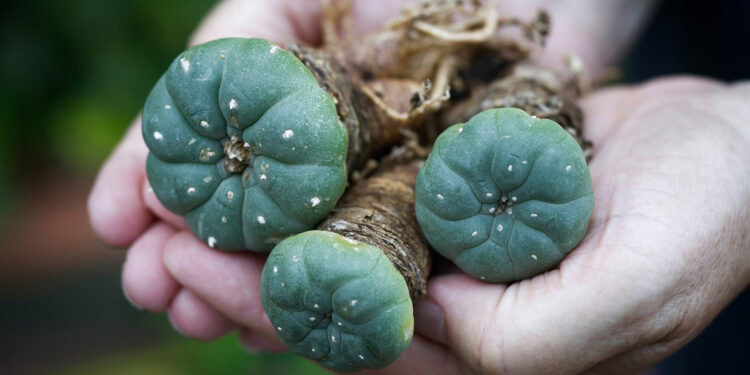

An ethnographic study of individuals who participated in peyote ceremonies in rural north-central Alabama revealed four core areas of personal change attributed to these ceremonies: reduced drug and alcohol misuse, new perspectives on life, improved mental health, and enhanced physical health. Participants attributed these changes to an improved ability to endure challenges, brain rewiring, and a deeper connection with their spiritual selves. The findings were published in the Journal of Drug Issues.
Peyote is a small, spineless cactus (Lophophora williamsii) native to parts of Mexico and the southwestern United States, renowned for its psychoactive properties. It contains mescaline, a naturally occurring hallucinogen that induces altered states of perception, mood, and consciousness.
Traditionally, peyote has been used by Indigenous peoples in spiritual ceremonies and healing practices due to its perceived ability to facilitate introspection and connection with the divine. Its use is restricted or regulated in many countries. In the United States, Native Americans are legally permitted to possess and ingest peyote as a religious sacrament. It has been a central element of the Native American Church since the early 20th century.
Study author Heith Copes and her colleagues sought to understand how individuals who use peyote in naturalistic settings perceive its impact on their lives. They aimed to explore how these individuals believe they have changed and what they attribute these changes to. The researchers believed that these insights could guide further investigation into the psychological effects, side effects, duration, and other characteristics of peyote.
The data were collected through a photo-ethnographic study of individuals who participated in peyote ceremonies in rural north-central Alabama. The study included formal interviews with 27 participants, informal observations during ceremonies, and photography. In total, the researchers conducted 46 interviews, as 14 individuals were interviewed more than once.
The researchers gained access to the group performing the peyote rituals through personal contacts with church leaders. After explaining their study goals and research plans, they were invited to attend the ceremonies.
The data collection process occurred in several stages. First, the researchers attended six ceremonies over a year and a half. They arrived a few hours before the ceremonies began to conduct ethnographic interviews, asking participants about their motivations for attending and their goals for the experience. The second data source consisted of semi-structured interviews conducted between ceremonies. Finally, photo-elicitation interviews were conducted with 16 of the 27 participants. This interviewing technique involves showing participants photographs to prompt responses and insights.
Of the 27 participants, 10 were women and 17 were men, ranging in age from 24 to 50 years old. One participant identified as White. All participants had prior experience using other psychedelics.
Overall, participants discussed four core areas of change they attributed to peyote use: reduced drug and alcohol misuse, new perspectives on life, improved mental health, and enhanced physical health. These changes were linked to an improved ability to endure challenges, brain rewiring, and a deeper connection with their spiritual selves.
“Nearly all participants found use of peyote in a ceremonial setting worthwhile, or at least potentially worthwhile. The most enduring outcome related to general mental health was an outlook that participants found refreshing and relieving. This outlook was often spiritual and philosophical and led to self-reflection. These lessons remained with participants although they were most salient in the short term,” the study authors concluded.
“Directly after taking peyote, between the next day and up to a few months, participants reported a sense that depression and anxiety symptoms were allayed and during this time, spiritual realizations were easily recalled and applied; participants reported doing positive mental and relationship work soon after ceremonies. An afterglow was typically reported as if it was a pharmacological form of relief, similar perhaps to antidepressants, but with far more robust effects.”
This study contributes to the scientific understanding of the personal experiences of participants in peyote ceremonies. However, it is important to note that this was an ethnographic study reporting solely subjective experiences as described by the participants.
The paper, “Hitting the Reset Button: Ceremonial Use of Peyote and Experiences of Personal Change,” was authored by Heith Copes, Andy Hochstetler, Jared Ragland, and Peter S. Hendricks.