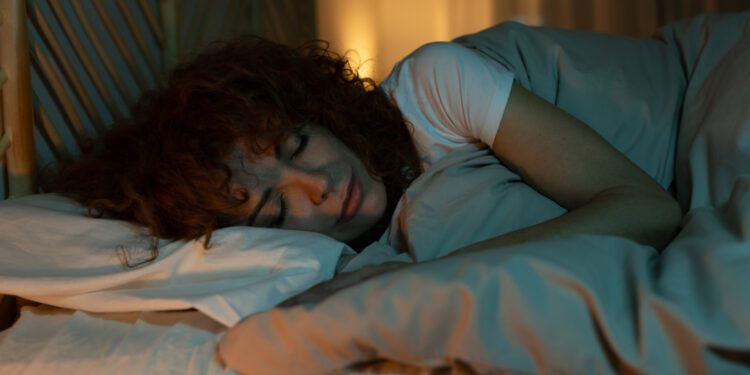
New research published in Communications Psychology indicates that dream content follows measurable patterns shaped by both enduring personal traits and major real-world events. Analyzing thousands of daily dream and waking reports collected over four years, scientists found that characteristics such as a tendency to let the mind wander, attitudes toward dreaming, and perceived sleep quality were associated with distinct features of dream narratives. The findings also suggest that large-scale stressors like the COVID-19 lockdown were tied to temporary shifts in dream themes and emotional intensity that gradually faded over the following years.
Dreams are conscious experiences made up of internally generated images, sensations, emotions, and unfolding scenarios that occur during sleep while the brain is partly disconnected from outside sensory input. Rather than serving as literal replays of daily routines, dreams tend to weave fragments of waking concerns and mental habits into altered narratives.
For example, a 2015 study of adults reporting their most recent dreams found that people who habitually try to push away unwanted thoughts during the day tended to dream more about their waking-life emotions. Similarly, an earlier study of work- and hobby-related dreams indicated that greater involvement in hobbies was linked to more frequent hobby-themed dreams, which tended to be more positive in tone than work-related or general dreams. In that same study, higher job stress was associated with more frequent work-related dreams.
Much of the existing literature on individual differences has focused on how frequently people remember their dreams rather than on what actually happens inside them. In a 2025 study by the same research team, drawing on a shared dataset of Italian adults, researchers found that sleep patterns and stable traits such as a positive attitude toward dreaming and proneness to mind wandering predicted how often participants recalled dreams upon waking. Mind wandering refers to the habit of letting thoughts drift spontaneously away from immediate tasks and surroundings.
Don’t miss the next big psychology finding
Every morning, PsyPost sends a short briefing on the most interesting new peer-reviewed research in psychology and neuroscience.
External crises can also reshape nighttime experiences, as shown in a 2022 longitudinal study in Italy co-authored by members of the current team, whose lockdown dream diaries are reanalyzed in the new paper. That earlier study found that strict COVID-19 confinement was tied to disrupted sleep and elevated dream recall, followed by shifts in dream themes such as crowded places once restrictions began to ease.
Still, earlier efforts to link personal characteristics and real-world events to dream content often relied on small samples, retrospective surveys, or manual scoring systems that made large-scale tracking difficult. To examine how enduring traits and major life events jointly shape dreaming over time, Valentina Elce, Giulio Bernardi, Giacomo Handjaras, and their colleagues conducted the new study at the MoMiLab Research Unit of the IMT School for Advanced Studies Lucca in Italy.
“Dreaming is a universal experience, yet we still know relatively little about why dream content differs so much between individuals and how it relates to our waking lives,” said lead author Valentina Elce, now an Alexander von Humboldt fellow in neuropsychology in the Department of Psychology at the University of Freiburg and a visiting research fellow in the Lucca unit’s Sleep, Plasticity and Conscious Experience Group. “Previous research has often focused on specific factors in isolation, or relied on relatively small samples and manual classification of dream reports. We wanted to take a more comprehensive approach, investigating whether dream content follows systematic patterns, how these differ from waking experiences, and to what extent they are shaped by individual characteristics and everyday life.”
Tracking thousands of dream and waking reports
Between March 2020 and March 2024, the researchers recruited healthy native Italian speakers in central and northern Italy through word of mouth and flyers. Eligible participants were aged 18 to 70, maintained regular sleep schedules of six to eight hours per night, and had no diagnosed sleep, neurological, or psychiatric conditions. After 10 volunteers withdrew, the main sample included 207 adults (117 women and 90 men, aged 18 to 69).
For 15 consecutive days at home, participants used a voice recorder each morning immediately upon waking to describe whatever had been going through their minds right before awakening, producing 1,687 usable dream reports. Once a day at unpredictable times, they also received a text prompt asking them to record their thoughts from the preceding 15 minutes. From 2,843 waking reports collected, the scientists selected 1,679 to match each participant’s dream count, drawing from days just before recorded dreams whenever possible and randomly substituting other waking reports in about 13 percent of matches.
Participants in the main group also completed questionnaires assessing their attitude toward dreaming, general anxiety, vividness of visual mental imagery, proneness to mind wandering, perceived sleep quality, and preference for morning or evening schedules. At the end of the tracking period, they underwent a one-hour cognitive battery covering general cognitive screening, language, memory, and attention.
From those tests, the researchers analyzed four measures: verbal memory, visuospatial memory (the ability to remember and reproduce complex visual shapes), resistance to mental distraction on a color-word interference test, and natural spoken verbosity on a picture-description task. Throughout the 15 days, volunteers also wore wrist-based motion trackers, a method known as actigraphy, to record objective sleep and wake patterns.
To examine how a major societal stressor related to dream content, the team incorporated a second, independent dataset collected during two weeks in spring 2020 spanning Italy’s strict COVID-19 lockdown and the initial easing of restrictions. That group consisted of 80 healthy Italian adults (60 women and 20 men, aged 19 to 41) recruited separately via social media, who contributed 351 morning dream reports.
After transcribing, anonymizing, and removing conversational filler from the recordings, the scientists analyzed all 3,717 reports using two complementary computational language approaches. First, three artificial intelligence large language models (Llama 3, ChatGPT-4, and ChatGPT-4 Turbo) scored every report on a nine-point scale across 16 predefined features, including sensory detail, abstract thought, emotional tone, emotional intensity, social interaction, personal control, constraints on freedom, and bizarreness. The researchers defined bizarreness as how illogical, strange, or internally inconsistent the described events were. For each report and feature, they used the median score across the three models as the final rating.
Second, a data-driven lexical method clustered related words into 32 thematic domains grouped under environment, community, and individual categories. In two validation checks, the automated ratings showed high agreement across all 16 dimensions with four trained human judges, and more moderate agreement with an independent group of volunteers who rated their own dreams, aligning closely on some features and more modestly on others.
The researchers named their dream-and-waking archive Somnieve. “I think one important contribution of this work is methodological,” Elce told PsyPost. “By combining these reports with psychological, cognitive, and sleep-related measures, and applying computational language analysis, we could investigate subjective experiences on a scale that would be extremely difficult to achieve through manual assessment alone. We also made the Somnieve dataset and the analysis pipeline publicly available, so that other researchers can explore the data and build on this work.”
How dreams differ from waking thoughts
Controlling for age, biological sex, education, and natural wordiness, the researchers found that dreams scored much higher than waking reports from the same people in bizarreness, visual and spatial detail, auditory and touch sensations, movement, shifting settings, and social interactions. Dreams also carried a more negative emotional tone, slightly stronger emotional intensity, and more references to limitations on freedom.
In contrast, waking reports contained far more abstract thoughts, stronger personal control over events, greater awareness of time passing, and more attention to bodily needs. References to the study procedures themselves were rare and did not show a statistically significant difference between dream and waking reports, which the authors take as evidence that participation did not systematically skew either report type.
Word-level themes showed a parallel split, with dreams more frequently mentioning elements of the physical environment such as animals (present in about 18 percent of dream reports compared with 9 percent of waking reports), locations, nature, objects, and physical appearances. Waking narratives leaned more toward personal concerns and community topics like healthcare, education, and timing, though several community and personal themes appeared more often in dreams, including work-related content (roughly 33 percent of dream reports versus 16 percent of waking reports) and danger-filled thriller scenarios.
In the authors’ interpretation, these patterns give dreams a cinematic structure in which the dreamer often adopts a spectator role inside an unfolding scene, aligning with theories proposing that dreams serve as mental simulations for rehearsing social dynamics, navigating threats, and processing emotional memories.
How personal traits and sleep quality relate to dreams
Next, the team examined how stable psychological and cognitive traits related to dream content while adjusting for all traits simultaneously, focusing on factors that affected dream reports differently from waking reports. Attitude toward dreaming stood out as a consistent predictor: people who viewed dreams as meaningful rather than random noise reported dreams higher in emotional intensity, bizarreness, visual richness, and spatial detail. Those differences did not appear in the same people’s waking reports. The trait also tracked references to geometric patterns and natural settings differently in dreams than in waking reports.
The authors propose two possible, non-exclusive explanations for this link. People strongly interested in dreams may pay closer attention to their inner experiences and remember richer details upon waking, though the authors note it is hard to explain why heightened attention alone would affect only specific perceptual features. Alternatively, a deeper, still unexplored mechanism may lead some people to experience more vivid, immersive dreams in the first place, reinforcing both recall and interest.
Higher daytime mind wandering was associated with greater dream bizarreness and more frequent shifts between dream settings. The authors suggest this aligns with theories that waking mind wandering and dreaming share overlapping brain systems, potentially involving the default mode network active during spontaneous inward thought.
Several cognitive and personal factors showed narrower links: participants better at resisting mental distraction on the color-word test reported more bizarre dreams, those with stronger visuospatial memory referenced objects more often in dreams, and younger adults mentioned job-related themes more frequently in dreams relative to waking life. People who naturally favored evening schedules focused more on communication in their waking reports than in their dreams, while demographic factors mostly shaped language similarly across waking and sleeping narratives.
“The main takeaway is that dreams are neither random nor simply a replay of what happens during the day,” Elce explained. “They reflect an interaction between who we are and what we experience, with the sleeping brain reorganizing fragments of everyday life into new scenarios. Our individual characteristics, such as our tendency to mind-wander and our attitude toward dreaming, also influence the way these experiences unfold. In a sense, dreams are another expression of our minds, operating under different conditions from waking life.”
Overall sleep patterns had relatively modest links to dream content, though perceived sleep quality played a more prominent role than objective wrist tracking. Participants who rated their sleep quality as better tended to report more bizarre dreams. Those reporting poorer sleep quality included fewer descriptions of physical matter and appearances in their waking reports relative to their dreams, a pattern the authors suggest fits with prior research linking poor sleep to reduced engagement with external surroundings. Among four objective sleep profiles derived from actigraphy, only prolonged light sleep was linked to dream content, corresponding to more frequent shifts in dream settings, while the links for sleep fragmentation and sleep timing measures were not statistically significant.
“One particularly interesting finding was the role of subjective sleep quality,” Elce noted. “How well participants felt they had slept was more strongly associated with certain characteristics of their dreams than objective sleep-wake patterns measured through actigraphy. This suggests that the subjective experience of sleep may be particularly relevant to understanding the subjective experience of dreaming.”
These findings fit alongside a previous study examining waking mind wandering and dreams, which found that dreams closely resembled spontaneous, task-unrelated waking thoughts. That earlier study also linked heightened daytime rumination (repetitive dwelling on distressing thoughts) and pandemic worry to more negative and distressing dreams.
The results also echo an earlier survey study of emotion regulation and dreaming, which indicated that people who more often reframed stressful waking thoughts tended to report lower negative emotions while awake, and in turn lower dream intensity and fewer typical dream themes. In that same study, difficulty managing positive emotions was directly linked to heightened dream intensity and more typical themes. However, that earlier research relied on retrospective questionnaires asking participants about their emotion regulation habits and typical dreams, whereas the new study analyzed daily prospective dream transcripts using automated language tools alongside cognitive tests and multi-year tracking.
Lockdown dreams and four years of gradual change
Comparing dream reports gathered during Italy’s spring 2020 COVID-19 lockdown with post-lockdown dreams recorded in the main dataset after May 2020, the researchers found marked thematic and emotional differences during confinement. Lockdown dreams scored higher in emotional intensity and contained more references to physical or social limitations, social interactions, setting shifts, and bodily experiences, alongside increases in fantasy, drama, work, and timing themes.
Looking at overall frequencies across the two datasets, drama-related language appeared in about 85 percent of lockdown dreams compared with 61 percent of dream reports across the full four-year main dataset. Job-related themes similarly appeared in about 54 percent of lockdown dreams versus 33 percent across the full main dataset. Notably, mentions of healthcare did not show a statistically significant difference between the lockdown and post-lockdown comparison groups, despite the pandemic’s medical focus.
Tracking the main cohort across the four years from 2020 to 2024, the scientists also observed gradual shifts as the pandemic receded. Dream bizarreness steadily declined over time, while across both dream and waking reports emotional tone grew more positive as emotional intensity, references to limitations, and society-related themes diminished. References to thoughts and time also declined over the four-year span, primarily in waking reports.
“I also found it striking how clearly a shared event such as the COVID-19 lockdown was reflected in dream reports, showing that even highly personal experiences are sensitive to broader social circumstances,” Elce added.
Caveats and future directions
As with all research, there are some caveats to keep in mind. Because the study is observational, the links connecting personal traits, the COVID-19 lockdown, and the passage of time to shifts in dream content cannot establish direct cause and effect.
“Our findings point to systematic associations between individual characteristics, life experiences, and specific features of dream content,” Elce pointed out. “However, these effects should be understood as probabilistic rather than deterministic: individual traits do not allow us to predict exactly what someone will dream about. Their significance lies primarily in showing that dream content can be studied quantitatively and that it contains measurable patterns related to both individual differences and external experiences. We also found that some factors were more consistently associated with dream content than others, highlighting the importance of considering multiple dimensions of individual experience.”
Another methodological caveat involves the pandemic comparison, which contrasted two separate groups rather than following the same individuals before and after confinement: the lockdown sample recruited via social media averaged about nine years younger than the main cohort and was three-quarters women. Although the models adjusted for age, sex, and education, the in-person picture-description test was unavailable for the lockdown group, forcing the team to control for verbosity using average word count, a proxy that correlated only weakly with the original test. Both cohorts also consisted of healthy Italian adults with regular sleep schedules and no sleep, neurological, or psychiatric diagnoses, without data on race, ethnicity, or socioeconomic status, so the patterns may differ in clinical groups or other cultural contexts.
“I would emphasize that our findings do not mean that dreams have a fixed symbolic meaning or that individual dreams can be interpreted as direct representations of someone’s psychological state,” Elce cautioned. “Our research focuses on the cognitive and neuroscientific processes underlying dreaming, rather than on interpreting the symbolic meaning of individual dream narratives. Another important limitation is that we necessarily rely on verbal reports, which capture what people remember and are able to describe about their experiences, rather than the entirety of the original dream experience. We addressed some of the potential influence of individual reporting styles by also collecting and analyzing waking reports, allowing us to compare the two types of experience within the same individuals.”
The authors also note in the paper that describing dreams as narrative or cinematic stems from patterns in spoken transcripts after waking, which may partly reflect how people organize memories into familiar storytelling structures rather than solely reflecting how dreams are built during sleep. Even so, they point out that finding consistent differences between waking and dream reports from the same volunteers suggests these patterns are not purely artifacts of how people tell stories, and may also reflect underlying differences in the experiences themselves.
“One of our main goals is to better understand the relationship between dreaming and memory,” Elce told PsyPost. “In particular, we want to investigate why the sleeping brain selects certain images, people, and scenes from our past and incorporates them into dreams, while leaving out countless other experiences. We are also interested in investigating how dream experiences change in neurological conditions and sleep disorders, where studying these changes may provide valuable insights into the underlying brain mechanisms and into the identification of potential behavioral markers of disease.”
The study, “Individual traits and experiences predict the content of dreams,” was authored by Valentina Elce, Giorgia Bontempi, Serena Scarpelli, Bianca Pedreschi, Pietro Pietrini, Luigi De Gennaro, Michele Bellesi, Giulio Bernardi, and Giacomo Handjaras.
