
Young infants show a preference for simple, high-contrast images that they naturally encounter in their daily lives, according to new research published in Science Advances. The findings suggest that the visual environment that young infants experience are unique to the early months after birth, providing insight into the type of visual experiences that are crucial for developing vision during this critical period.
The primary motivation for the study was to fill a significant gap in understanding how real-world visual experiences contribute to the development of the visual system in infants. Vision development is highly dependent on early visual experiences, and disruptions during this critical period can have long-lasting consequences. While much is known about how visual abnormalities like cataracts and strabismus affect visual development, there is limited knowledge about the everyday visual input that healthy infants receive.
Traditionally, it has been assumed that the visual input from daily life is relatively similar for all individuals, regardless of age. However, observations from controlled laboratory studies suggested that infants exhibit strong preferences for simple, high-contrast patterns. These observations raised the possibility that infants’ visual experiences in their natural environments might be distinctly different from those of older children and adults.
“Human development is experience-dependent in all sensory domains as well as cognition. However, we know very little about the daily life experiences of infants and children — the context in which development happens,” said study author Linda B. Smith, a professor of psychological and brain sciences at Indiana University.
“Most people, when they think about a statement like this, consider factors such as good homes, bad homes, poverty, and parental actions. Certainly, these are relevant topics. But the fact is the developing infant and child plays a direct role in structuring their own environment in ways that are critical to development — where they look, how and how much they vocalize, and later on, how they play and manipulate objects. Understanding this is critical because many neurotypical developmental pathways are also characterized by sensory-motor disruptions or oddities.”
“Much of my work involves putting head cameras and wearable sensors on babies to understand (1) how they influence their environments in real-time behavior and (2) how fundamental properties of experiences and environments change systematically with development as babies’ motor skills and interests change,” Smith continued.
“Little babies — the topic of this paper (under 4 months of age) — are generally characterized as not being able to do much; even eye and head movements are slow and awkward, and posture shifts are uncontrolled and uncommon. Do they nonetheless structure their own environments? Well, yes, they do, even within the full complexity of daily life environments.”
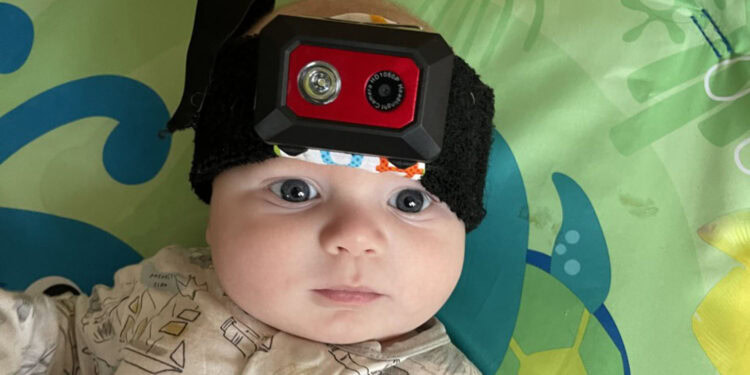
The researchers equipped ten infants (aged 3 to 13 weeks) and ten adults (aged 31 to 71 years) with head-mounted cameras to capture their visual experiences. These cameras recorded egocentric images — pictures from the wearer’s perspective — during their daily activities.
The cameras were lightweight, ensuring they did not interfere with the infants’ normal behavior. Parents were trained to position the cameras correctly on the infants’ heads, and recordings were done at home without the presence of experimenters. In total, 41.5 hours of infant video and 30.75 hours of adult video were collected, resulting in 25,000 images from each group.
The images were analyzed for two main properties: edge simplicity and visibility. Edge simplicity was measured by the number of edges and their orientation consistency, while visibility was assessed through the contrast properties of the images. The researchers used sophisticated image processing techniques to quantify these properties and compared the distributions of these properties between infant and adult images.
The analysis revealed significant differences between the visual inputs of infants and adults. Infants’ images were characterized by fewer edges and simpler patterns. Specifically, 36% of the infant images had high values on at least three of the four measures of edge simplicity and visibility, compared to only 7% of the adult images. This indicates that infants are exposed to a higher proportion of simple, high-contrast scenes.
“We know from lab studies that young babies like to look at high-contrast, simple visual patterns,” Smith told PsyPost. “This study shows they can find and sustain their gaze on simple patterns amid the clutter of daily life visual scenes. We know these patterns support cortical visual development.”
Further examination showed that infants often viewed scenes with architectural elements like windows, doors, and corners—features with clear, simple edges. These scenes were prevalent in infants’ daily environments and matched their laboratory preferences. Notably, these scenes stayed in view for longer durations for infants than for adults, suggesting that infants’ visual behaviors contribute to their prolonged exposure to these preferred patterns.
“The degree to which infants’ daily life experiences were biased towards simple high-contrast patterns was surprising,” Smith said. “We hoped to see some bias but did not expect that either the world would offer so many opportunities or that little baby behavior could manage to find and sustain attention to simple scenes. But they do.”
To visualize these differences, the researchers created a two-dimensional space based on the simplicity and visibility measures. In this visualization, infant images were more frequently found in the quadrant representing high simplicity and high visibility. This quadrant contained images with fewer edges, more consistent orientations, and higher contrast—precisely the types of patterns that infants prefer in laboratory settings.
Additionally, the researchers conducted a cluster analysis to categorize the images into different types based on their properties. They identified three main clusters: Simple, Complex, and Texture. The Simple cluster, characterized by fewer edges and orientations, contained 73% of the infant images but only 52% of the adult images. This further highlighted the prevalence of simple, high-contrast scenes in infants’ visual experiences.
The findings demonstrate how “the experiences of infants are shaped by their own behavior, and this is true even for very young infants,” Smith told PsyPost. “Knowing this is key to ensuring all infants—preterm, or those with potential difficulties in producing the right behaviors—get the optimal experiences for development by helping them produce the right behaviors or finding workarounds to get the right experiences at the right time.”
While this study provides valuable insights into infants’ visual experiences, it also has limitations. The data were collected in typical working- to middle-class homes in Bloomington, Indiana. The researchers acknowledge that visual environments can vary significantly across different cultural and socioeconomic contexts. Therefore, the findings may not be universally applicable.
To address this, the researchers conducted a similar study in a different cultural context, an under-resourced village in India. This will help determine whether the observed edge-simplicity bias is a general feature of early visual development or specific to certain environments.
“We have finished collecting the data and are analyzing it now. This is critical to making conclusions about development in general,” Smith said.
Another limitation is the reliance on head-mounted cameras, which capture the visual field but not the exact gaze direction of infants. Future studies could benefit from using eye-tracking technology to provide more precise measurements of where infants are looking.
The study, “An edge-simplicity bias in the visual input to young infants,” was authored by Erin M. Anderson, T. Rowan Candy, Jason M. Gold, and Linda B. Smith.