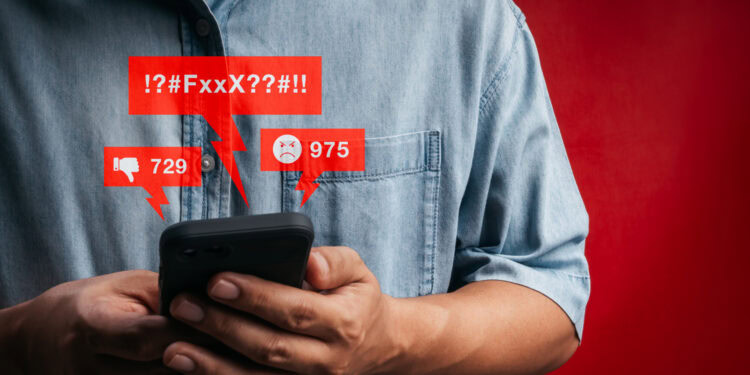

Subtle grammatical choices in political social media posts are linked to how much hostility users express in the comment sections below them. A large-scale analysis of Facebook discussions published in Social Psychological and Personality Science indicates that posts referring to political groups with nouns rather than adjectives, or making sweeping generalizations about a party, tend to attract a higher proportion of prejudiced replies. Although the effect of any single post is small, the findings suggest that everyday wording habits online could gradually contribute to political division.
Hostility between opposing party supporters, which social scientists call affective polarization, has risen in the United States and several other democracies. Affective polarization refers to the tendency for citizens to view members of an opposing political party with dislike and distrust while favoring their own political group. At high levels, this animosity can lead voters to treat political rivals as enemies rather than fellow citizens, a dynamic linked to eroding trust in democratic institutions.
Sorting people into “us” versus “them” naturally creates some group bias, yet the intensity of that bias depends heavily on a psychological concept known as entitativity. Entitativity describes the extent to which an observer perceives a collection of people as a unified, tightly knit whole rather than a loose assortment of individuals. Supporting this idea, a 2018 meta-analysis of 33 samples found that the more people view an outside group as a coherent entity, the more prejudice they tend to hold toward its members. In politics, research has indicated that believing partisans are fundamentally different kinds of people was linked to greater partisan hostility, through more blame and assumed malicious intent, whereas believing political views themselves are fixed was linked to less.
“In essence, perceiving a group as entitative makes group members appear more interchangeable,” study author Carsten W. Sander, a research associate at Humboldt University of Berlin who conducted the research at Universität Hamburg with co-author Juliane Degner, a professor of social psychology there, told PsyPost. “People then generalize one member’s behavior to the whole group, retaliate against one group member for offenses committed by another, and generally show more outgroup prejudice. We reasoned that this could also fuel political polarization, understood as growing prejudice toward the political outparty.”
Because national political parties contain millions of people, citizens cannot observe an entire party firsthand and instead rely on media and conversation to judge how unified the other side is. Beyond explicit statements about a group, grammatical structures can quietly signal uniformity. One such cue is whether a writer uses a noun label, such as “Senate Republicans,” or an adjective label, such as “Republican senators.” Using a noun defines a person primarily by a single group category, whereas an adjective treats party affiliation as just one trait among many.
Controlled experiments show that these grammatical distinctions shape how people judge unfamiliar or minority groups. For instance, a 2020 study of print news readers found that articles describing an ethnic minority member with a noun rather than an adjective led readers to express slightly greater prejudice toward that entire minority group, whether the story was positive or negative.
A second cue involves generic statements, which are broad claims attributing an enduring trait to a group as an abstract whole, such as “Democrats want climate action,” rather than non-generic phrasing like “some Democrats want climate action.” In a 2010 experimental study of children and adults, participants who learned about a fictional animal category through generic statements were more likely to treat its members as sharing the same underlying nature, though the effect was weaker in children.
Most evidence on noun labels and generic phrasing comes from laboratory studies involving fictional or unfamiliar categories. Sander and Degner wanted to test whether these subtle wording differences also influence hostility toward established political groups like U.S. Democrats and Republicans in real-world online conversations. The authors noted that the relative frequency of partisan noun labels in U.S. online news has risen substantially in recent years, raising the question of how such language plays out on social media.
To examine this in a natural setting, the researchers gathered public Facebook posts and comments through the Meta Content Library. They selected Facebook because it has a diverse American user base and frequently hosts text-based political discussions. After excluding posts in which party labels referred to institutions or events rather than people (such as “the Democratic Party” or “the Republican primary”), the final sample included 45,780 posts and 769,684 direct replies written by 391,386 unique users across 3,878 pages and profiles. News media outlets contributed the largest share of posts, alongside public figures, politicians, and government officials.
To analyze hundreds of thousands of messages, the authors fine-tuned five artificial intelligence models built on transformer architectures, which are machine-learning programs that process language by evaluating how words relate in context. They trained and tested these models on thousands of human-coded examples, supplemented for two of the models with 600 synthetic posts written in matched pairs that differed in only one feature. One model classified whether a post used a party label as a noun (such as “voting Democrats”) or an adjective (such as “Democratic voters”). A second model identified whether the post made a broad generic claim about a group as a whole or a non-generic statement limited by qualifiers or referring to a single past action.
To account for other factors that might provoke angry replies, the models also tracked whether each post referred to a single individual, a subgroup (such as “House Republicans”), or the broader party, and whether the original post itself expressed hostility toward a political party. A separate model evaluated all 769,684 comments to detect partisan prejudice, defined as dislike or negativity aimed at a political group or collective target (such as “Dems are the worst” or “Idiots!”), while excluding remarks aimed only at a single person (such as “I hate Biden”). The researchers publicly registered their hypotheses and analysis plan in advance.
The researchers then used multilevel statistical models to test whether the wording of a specific post predicted the proportion of prejudiced comments below it. Comparing different posts published on the exact same Facebook page allowed the analysis to account for unmeasured differences between pages and their audiences. Across all 45,780 posts, posts using noun labels received a higher proportion of prejudiced comments than posts on the same page using adjective labels. Before controls, the odds that any given comment expressed partisan prejudice were 1.39 times higher beneath noun-label posts than beneath adjective-label posts, an odds ratio that fell to 1.15 after controlling for post prejudice and whether the target was an individual, subgroup, or whole party.
In practical terms, on a typical Facebook page where 59 percent of posts used noun labels, the model predicted that 16.7 percent of comments under a noun-label post would express partisan prejudice, compared with 14.8 percent under an adjective-label post. That is an absolute difference of 1.9 percentage points, or a relative difference of about 13 percent. By contrast, a page’s overall average use of noun labels across all its posts was not a statistically significant predictor of comment prejudice after controls were added, which the authors interpret as a sign that commenters were responding to the wording of the specific post, though they caution that comparisons between pages are vulnerable to hidden differences.
For their second main analysis, the authors tested generic language across the 26,026 posts and 437,744 comments that referred to political groups or subgroups rather than specific individuals. Posts using party labels generically drew a higher share of prejudiced replies than non-generic posts, with an odds ratio of 1.22 before adjustments and 1.20 after controlling for noun usage, post prejudice, and whether the post targeted a subgroup or the broader party.
On a typical page where 29 percent of posts were generic, the predicted probability of a prejudiced comment was 22.2 percent under generic posts versus 19.2 percent under non-generic posts, an absolute difference of 3.0 percentage points or a relative difference of roughly 16 percent. At the page level, pages that posted generic statements more often actually drew somewhat fewer prejudiced comments once other factors were accounted for, a pattern the authors attribute to other differences between pages rather than to the wording itself.
In that second analysis, noun labels continued to independently predict higher rates of prejudiced comments alongside generic phrasing, indicating that each feature was linked to online hostility on its own. Supplementary analyses also showed that these patterns held true whether posts mentioned Democrats or Republicans. Even when comparing different comments written by the exact same user across multiple posts, noun and generic labels still predicted more prejudiced replies, which the authors interpret as a sign that the language affected how users commented rather than merely attracting already hostile users.
These findings align with a study covered by PsyPost in early 2024, which found that broad generic statements about political parties led people to perceive a wider ideological gap between Democrats and Republicans than statements containing qualifiers like “some.” That earlier research measured perceived ideological divides in survey experiments, whereas the new study indicates that generic phrasing is also linked to hostile expressions in real-world social media discussions.
There are a few things to keep in mind when interpreting these results. Because the study observed existing social media activity rather than randomly assigning different wordings to readers, it cannot establish with certainty that grammatical labels directly caused the increase in prejudiced replies. In addition, the study only captured whether someone wrote a hostile comment in the moment, leaving open whether noun or generic labels create lasting attitude shifts or briefly trigger existing frustrations.
“The key caveat is that the findings are observational,” Sander explained. “Features of the post content that we didn’t control for could be driving both the labeling and the prejudiced comments, so the results shouldn’t be read as showing that labels cause prejudice.” Still, he added, “our results and earlier experimental research are consistent with that possibility.”
The automated classifiers were also imperfect. In test data, the model that detected prejudiced comments caught about 73 percent of them, and about 68 percent of the comments it flagged were truly prejudiced, so some misclassification is likely.
Another caveat is that the statistical effects of a single post’s wording are small, and subtle cues from nouns or generic statements might be overshadowed by explicit news about party infighting or unanimous votes. At the same time, the authors propose that labeling habits could spread through social networks, as one person’s phrasing influences another’s, a possibility they say still needs testing. They also argue that even if a post only briefly nudges a few users to leave hostile replies, those comments remain visible on the page, where they could give other readers an exaggerated impression of how much the opposing party dislikes them.
“The effects were small: about 15% prejudiced comments under adjective labels versus 17% under noun labels,” Sander said. “If they turn out to be causal, though, they could nevertheless matter in practice: Labeling choices by high-reach news outlets could affect very large audiences, and small effects may accumulate as people read many posts over time.”
To test whether changing how parties are labeled actually reduces online hostility, the researchers hope to evaluate these wording variations in real-world trials over extended periods. “The next step would be an experimental replication, for example in collaboration with an online news outlet that would let us randomly vary the labeling in its social media posts, as this would allow us to establish causality,” Sander noted.
Future studies could also examine whether shifting toward adjective labels, qualifiers like “some,” or person-first phrasing such as “people who voted Republican” helps cool down political comment sections. Researchers might additionally test whether describing discrete past actions, such as “Republicans voted,” rather than permanent group traits, such as “Republicans are,” tempers partisan animosity.
The study, “Constructing the Enemy: Noun and Generic Party Labels Predict Partisan Prejudice in Social Media Comments,” was authored by Carsten W. Sander and Juliane Degner.