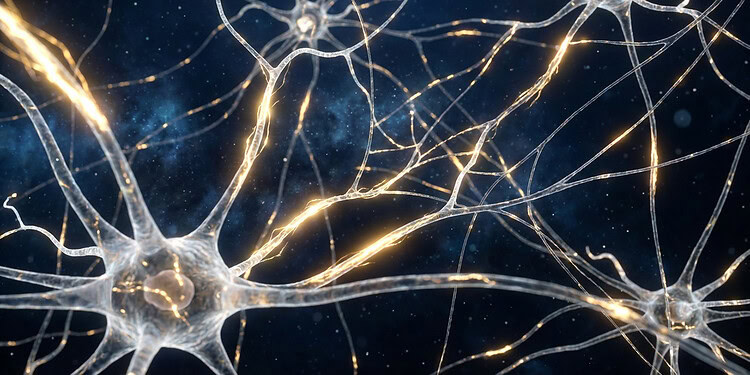

A new study in mice indicates that long-term treadmill exercise might fully reverse memory problems and reduce brain damage associated with Alzheimer’s disease. The research suggests these benefits are tied to the activation of a specific cellular communication pathway that promotes brain health and reduces inflammation. The findings were published in Scientific Reports.
Alzheimer’s disease is a progressive brain disorder characterized by memory loss and a decline in thinking skills. At a cellular level, the disease involves the buildup of toxic protein fragments known as amyloid plaques and tau tangles. These protein clusters disrupt communication between brain cells and trigger chronic inflammation.
Glial cells, which include microglia and astrocytes, act as the brain’s immune system. They initially try to clear away the toxic proteins. But in Alzheimer’s disease, these cells often become stuck in a hyperactive state, which damages healthy neurons and worsens the condition. A 2024 review indicated that physical exercise can help calm this brain inflammation by shifting microglia and astrocytes back into a protective state.
Scientists are still trying to understand exactly how exercise produces these positive changes in the brain. The authors of the new study focused on a specific chemical messenger system known as the brain-derived neurotrophic factor pathway. Brain-derived neurotrophic factor, or BDNF, is a protein that acts like fertilizer for the brain, helping neurons survive, grow, and form new connections.
When this protein binds to its target receptor, called TrkB, it sets off a chain reaction inside the cell that promotes survival and blocks cell death. A 2024 review suggested that physical exercise boosts these protein levels, which helps protect memory during neurodegenerative diseases. Similarly, a 2024 paper proposed that boosting this signaling system can stimulate the repair of myelin, which is the protective coating around nerve fibers that often degrades in Alzheimer’s disease. The researchers wanted to see if the activation of this specific signaling complex could explain the wide-ranging benefits of exercise on Alzheimer’s pathology.
The research, led by Taewan Kim and Hyunsik Kang at Sungkyunkwan University, involved 40 male mice. Half of the mice were genetically modified to develop features of Alzheimer’s disease, including amyloid plaques, tau tangles, and memory deficits. The other half were typical, healthy mice.
Within both the Alzheimer’s model and the healthy groups, the researchers randomly assigned half the mice to an exercise program and half to a sedentary control group. The exercising mice ran on a motorized treadmill for 30 minutes a day, five days a week, for a total of 20 weeks. The speed of the treadmill was gradually increased over the months to maintain a steady physical challenge.
To test cognitive function, the researchers used a water maze at the end of the 20 weeks. The mice had to swim in a small pool to find a hidden platform. The scientists recorded how long it took the mice to learn the platform’s location and how well they remembered it the following day. Afterward, the researchers analyzed the brain tissue and blood of the mice to measure various proteins, inflammatory markers, and cellular changes.
The Alzheimer’s mice that remained sedentary showed severe memory impairments, taking much longer to find the hidden platform than the healthy mice. But the Alzheimer’s mice that exercised performed just as well as the healthy mice, displaying a full recovery of their spatial learning and memory skills.
At the cellular level, the exercising Alzheimer’s mice had substantially lower levels of amyloid plaques and tau tangles in the hippocampus, a brain region vital for memory. The researchers found that treadmill running strongly activated the BDNF-TrkB signaling pathway. This activation was accompanied by a decrease in inflammatory molecules in the blood and brain.
The exercise routine also prompted a shift in the brain’s immune cells. Microglia and astrocytes in the exercising mice transitioned away from a toxic, inflammatory state and toward a restorative, anti-inflammatory state. The findings are in line with research covered by PsyPost in 2021, which found that voluntary physical exercise reversed cognitive impairment and prompted structural changes in astrocytes near amyloid plaques in an Alzheimer’s mouse model.
In addition to calming inflammation, the treadmill running protected the brain’s infrastructure. The exercising Alzheimer’s mice showed improved function in their mitochondria, which are the energy-producing structures inside cells. The researchers also noted a reduction in myelin damage and a decrease in the rate of neuronal cell death compared to the sedentary Alzheimer’s mice. The results align with another study covered by PsyPost in 2025, which observed that regular aerobic exercise reduced tau tangles, amyloid plaques, and myelin damage in naturally aged rats, though the new study specifically examined a genetically modified Alzheimer’s model.
The study provides detailed insights into the brain’s response to physical activity, but there are some caveats to consider. The research was conducted using a mouse model, meaning the findings might not translate directly to human patients with Alzheimer’s disease. The mice also began exercising at four months of age, which corresponds to the early stages of the disease in this specific genetic model. It is unknown if starting an exercise regimen later in the disease’s progression would yield similar benefits.
The researchers focused on changes in protein levels and cellular markers rather than directly blocking the BDNF-TrkB pathway to see if the benefits disappeared. Because of this, it is difficult to determine with absolute certainty that this specific pathway is the sole cause of the improvements. Exercise releases a wide variety of chemical messengers from muscles, which might also travel to the brain and contribute to neuroprotection.
Future research could explore how different types, durations, and intensities of exercise affect brain health in older adults. Scientists also plan to investigate whether these cellular improvements occur in other brain regions beyond the hippocampus.
The study, “Exercise training-induced benefits for Alzheimer’s disease are associated with modulation of the BDNF-TrkB signaling complex,” was authored by Taewan Kim, Jinkyung Cho, and Hyunsik Kang.