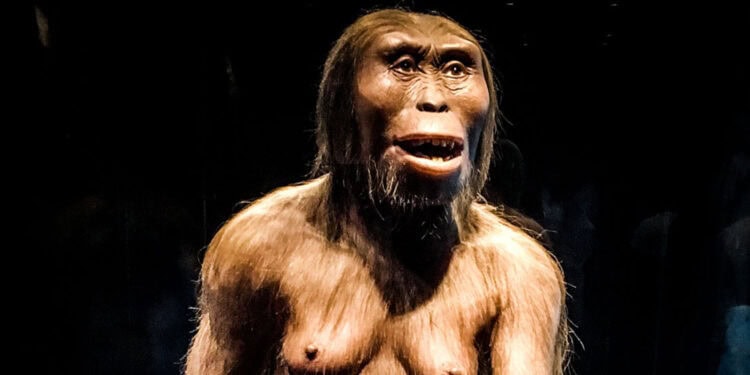

Fifty years ago, scientists discovered a nearly complete fossilized skull and hundreds of pieces of bone of a 3.2-million-year-old female specimen of the genus Australopithecus afarensis, often described as “the mother of us all.” During a celebration following her discovery, she was named “Lucy,” after the Beatles song “Lucy in the Sky with Diamonds.”
Though Lucy has solved some evolutionary riddles, her appearance remains an ancestral secret.
Popular renderings dress her in thick, reddish-brown fur, with her face, hands, feet and breasts peeking out of denser thickets.
This hairy picture of Lucy, it turns out, might be wrong.
Technological advancements in genetic analysis suggest that Lucy may have been naked, or at least much more thinly veiled.
According to the coevolutionary tale of humans and their lice, our immediate ancestors lost most of their body fur 3 to 4 million years ago and did not don clothing until 83,000 to 170,000 years ago.
That means that for over 2.5 million years, early humans and their ancestors were simply naked.
As a philosopher, I’m interested in how modern culture influences representations of the past. And the way Lucy has been depicted in newspapers, textbooks and museums may reveal more about us than it says about her.
From nudity to shame
The loss of body hair in early humans was likely influenced by a combination of factors, including thermoregulation, delayed physiological development, attracting sexual partners and warding off parasites. Environmental, social and cultural factors may have encouraged the eventual adoption of clothing.
Both areas of research – of when and why hominins shed their body hair and when and why they eventually got dressed – emphasize the sheer size of the brain, which takes years to nurture and requires a disproportionate amount of energy to sustain relative to other parts of the body.
Because human babies require a long period of care before they can survive on their own, evolutionary interdisciplinary researchers have theorized that early humans adopted the strategy of pair bonding – a man and a woman partnering after forming a strong affinity for one another. By working together, the two can more easily manage years of parental care.
Pair bonding, however, comes with risks.
Because humans are social and live in large groups, they are bound to be tempted to break the pact of monogamy, which would make it harder to raise children.
Some mechanism was needed to secure the social-sexual pact. That mechanism was likely shame.
In the documentary “What’s the Problem with Nudity?” evolutionary anthropologist Daniel M.T. Fessler explains the evolution of shame: “The human body is a supreme sexual advertisement… Nudity is a threat to the basic social contract, because it is an invitation to defection… Shame encourages us to stay faithful to our partners and share the responsibility of bringing up our children.”
Boundaries between body and world
Humans, aptly described as “naked apes,” are unique for their lack of fur and systematic adoption of clothing. Only by banning nudity did “nakedness” become a reality.
As human civilization developed, measures must have been put in place to enforce the social contract – punitive penalties, laws, social dictates – especially with respect to women.
That’s how shame’s relationship to human nudity was born. To be naked is to break social norms and regulations. Therefore, you’re prone to feeling ashamed.
What counts as naked in one context, however, may not in another.
Bare ankles in Victorian England, for example, excited scandal. Today, bare tops on a French Mediterranean beach are ordinary.
When it comes to nudity, art doesn’t necessarily imitate life.
In his critique of the European oil painting tradition, art critic John Berger distinguishes between nakedness – “being oneself” without clothes – and “the nude,” an art form that transforms the naked body of a woman into a pleasurable spectacle for men.
Feminist critics such as Ruth Barcan complicated Berger’s distinction between nakedness and the nude, insisting that nakedness is already shaped by idealized representations.
In “Nudity: A Cultural Anatomy,” Barcan demonstrates how nakedness is not a neutral state but is laden with meaning and expectations. She describes “feeling naked” as “the heightened perception of temperature and air movement, the loss of the familiar boundary between body and world, as well as the effects of the actual gaze of others” or “the internalized gaze of an imagined other.”
Nakedness can elicit a spectrum of feelings – from eroticism and intimacy to vulnerability, fear and shame. But there is no such thing as nakedness outside of social norms and cultural practices.
Lucy’s veils
Regardless of her fur’s density, then, Lucy was not naked.
But just as the nude is a kind of dress, Lucy, since her discovery, has been presented in ways that reflect historical assumptions about motherhood and the nuclear family. For example, Lucy is depicted alone with a male companion or with a male companion and children. Her facial expressions are warm and content or protective, reflecting idealized images of motherhood.
The modern quest to visualize our distant ancestors has been critiqued as a sort of “erotic fantasy science,” in which scientists attempt to fill in the blanks of the past based on their own assumptions about women, men and their relationships to one another.
In their 2021 article “Visual Depictions of Our Evolutionary Past,” an interdisciplinary team of researchers tried a different approach. They detail their own reconstruction of the Lucy fossil, bringing into relief their methods, the relationship between art and science, and decisions made to supplement gaps in scientific knowledge.
Their process is contrasted with other hominin reconstructions, which often lack strong empirical justifications and perpetuate misogynistic and racialized misconceptions about human evolution. Historically, illustrations of the stages of human evolution have tended to culminate in a white European male. And many reconstructions of female hominins exaggerate features offensively associated with Black women.
One of the co-authors of “Visual Depictions,” sculptor Gabriel Vinas, offers a visual elucidation of Lucy’s reconstruction in “Santa Lucia” – a marble sculpture of Lucy as a nude figure draped in translucent cloth, representing the artist’s own uncertainties and Lucy’s mysterious appearance.
The veiled Lucy speaks to the complex relationships among nudity, covering, sex and shame. But it also casts Lucy as a veiled virgin, a figure revered for sexual “purity.”
And yet I can’t help but imagine Lucy beyond the cloth, a Lucy neither in the sky with diamonds nor frozen in maternal idealization – a Lucy going “Apeshit” over the veils thrown over her, a Lucy who might find herself compelled to wear a Guerrilla Girls mask, if anything at all.
This article is republished from The Conversation under a Creative Commons license. Read the original article.