Subscribe
The latest psychology and neuroscience discoveries.
My Account
  • Mental Health
  • Social Psychology
  • Cognitive Science
  • Neuroscience
  • About
No Result
View All Result
PsyPost
PsyPost
No Result
View All Result
Home Exclusive Social Psychology

Women’s perceptions of their attractiveness linked to preferences for male facial masculinity

by Eric W. Dolan
September 21, 2020
in Social Psychology
Share on TwitterShare on Facebook

Heterosexual women who consider themselves to be attractive tend view more masculine-looking male faces as more attractive, according to new research published in the journal Evolution and Human Behavior.

“Previous work investigating whether more attractive women preferred more masculine men had reported mixed results, but had mostly tested small samples of women. In particular, studies assessing whether women rated by other people as being particularly attractive had tested very small numbers of women only,” said study author Ben Jones, a professor at the University of Strathclyde.

“We ran two large studies to examine whether women who considered themselves to be particularly attractive or who were rated by other people as being particularly attractive preferred more masculine men. We found that only women’s ratings of their own attractiveness predicted their preference for masculine men.”

For their new study, the researchers collected data from 454 heterosexual women who visited a lab and 8,972 heterosexual women who completed the study online. The participants were shown pairs of faces and asked to indicate which one was more attractive. To obscure the purpose of the study, the participants were also asked to assess various other facial traits.
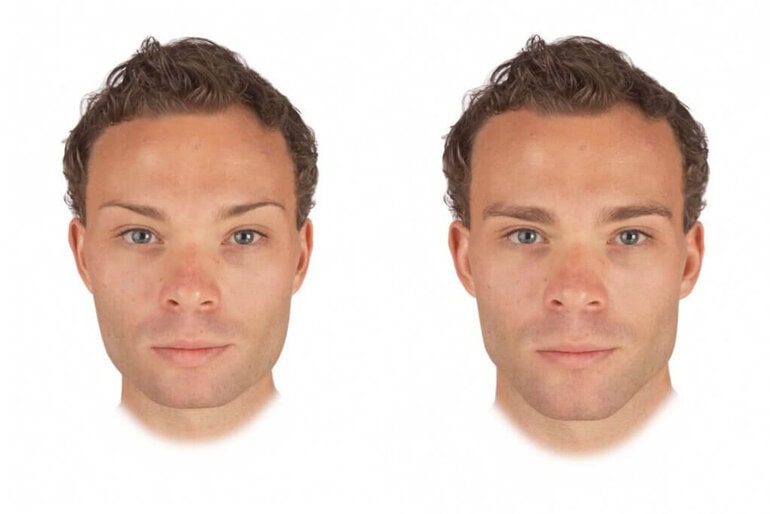
An example of a feminized (left) face and masculinized (right) face used in the current study.

The participants who visited the lab were also photographed (without makeup), and a separate group of 16 men and 16 women rated their facial attractiveness. Participants who completed the study online, on the other hand, provided a rating of their own self-assessed attractiveness.

Jones and his colleagues found that women’s facial attractiveness, as rated by others, was not associated with their preferences for facial masculinity. But the researchers did find that women who rated themselves as more attractive were more likely to view more masculine male faces as more attractive.

“It appears to be women’s perceptions of their own attractiveness, rather than how attractive other people think they are, that is key to their masculinity preference,” Jones told PsyPost.

But like all research, the new study includes some caveats.

Google News Preferences Add PsyPost to your preferred sources

“We might see different results if we used other methods to assess women’s attractiveness (e.g. assessed the attractiveness of their behavior or bodies) or assessed masculinity preferences using images of men’s bodies or recordings of their voices. We also only tested straight women’s masculinity preferences. These results might not generalize to gay or bisexual women,” Jones explained.

“While it looks like women’s ratings of their own attractiveness do predict their masculinity preferences, we still don’t really know why. Previous researchers have suggested that women who think they are particularly attractive might consider themselves to be better placed to likely to attract masculine men as long-term partners. However, there have been no direct tests (yet) of this assumption.”

The study, “Do more attractive women show stronger preferences for male facial masculinity?“, was authored by Ciaran Docherty, Anthony J. Lee, Amanda C. Hahn, Lisa M. DeBruine, and Benedict C. Jones.

Previous Post

Study explores the link between racial attitudes and NFL attendance during Black Lives Matter protests

Next Post

People who are high in vulnerable narcissism are more likely to feel shame on a daily basis

RELATED

Study sheds light on the truth behind the “deceptive stability” of abortion attitudes
Social Psychology

Abortion stigma persists at moderate levels in high-income countries

March 6, 2026
Employees who feel attractive are more likely to share ideas at work
Attractiveness

Employees who feel attractive are more likely to share ideas at work

March 6, 2026
Pro-environmental behavior is exaggerated on self-report questionnaires, particularly among those with stronger environmentalist identity
Climate

Conservatives underestimate the environmental impact of sustainable behaviors compared to liberals

March 5, 2026
Common left-right political scale masks anti-establishment views at the center
Political Psychology

American issue polarization surged after 2008 as the left moved further left

March 5, 2026
Evolutionary psychology reveals patterns in mass murder motivations across life stages
Authoritarianism

Psychological network analysis reveals how inner self-compassion connects to outward social attitudes

March 5, 2026
Republicans’ pro-democracy speeches after January 6 had no impact on Trump supporters, study suggests
Conspiracy Theories

Trump voters who believed conspiracy theories were the most likely to justify the Jan. 6 riots

March 5, 2026
Scientists discover psychedelic drug 5-MeO-DMT induces a state of “paradoxical wake”
Business

Black employees struggle to thrive under managers perceived as Trump supporters

March 4, 2026
Self-interest, not spontaneous generosity, drives equality among Hadza hunter-gatherers
Dating

Asexual women tend to prioritize different traits in a partner compared to heterosexual women

March 3, 2026

STAY CONNECTED

LATEST

How the wording of a trigger warning changes our psychological response

Dating and breakups take a heavy emotional toll on adolescent mental health

Abortion stigma persists at moderate levels in high-income countries

Brain scans reveal two distinct physical subtypes of ADHD

Employees who feel attractive are more likely to share ideas at work

New psychology research reveals that wisdom acts as a moral compass for creative thinking

Long-term ADHD medication use does not appear to permanently alter the developing brain

Using cannabis to cut back on alcohol? Your working memory might dictate if it works

PsyPost is a psychology and neuroscience news website dedicated to reporting the latest research on human behavior, cognition, and society. (READ MORE...)

  • Mental Health
  • Neuroimaging
  • Personality Psychology
  • Social Psychology
  • Artificial Intelligence
  • Cognitive Science
  • Psychopharmacology
  • Contact us
  • Disclaimer
  • Privacy policy
  • Terms and conditions
  • Do not sell my personal information

(c) PsyPost Media Inc

Welcome Back!

Login to your account below

Forgotten Password?

Retrieve your password

Please enter your username or email address to reset your password.

Log In

Add New Playlist

Subscribe
  • My Account
  • Cognitive Science Research
  • Mental Health Research
  • Social Psychology Research
  • Drug Research
  • Relationship Research
  • About PsyPost
  • Contact
  • Privacy Policy

(c) PsyPost Media Inc