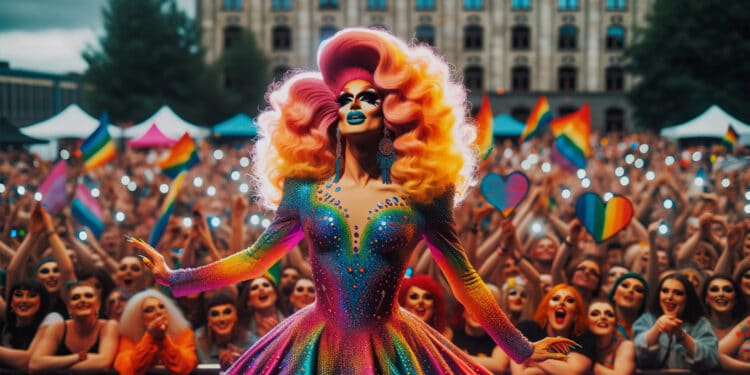

New research published in Psychology of Sexual Orientation and Gender Diversity sheds light on the potential therapeutic and community-building aspects of drag. While the study reaffirms that depression rates are notably elevated among drag performers, the research identifies social support and creativity as crucial factors contributing to psychological resilience in this community.
Drag performance is a vibrant and expressive form of art that has gained significant visibility in recent years, thanks in part to popular TV shows like RuPaul’s Drag Race. While drag may seem glamorous and empowering, prior research had already hinted at underlying mental health concerns among drag performers. A study conducted by Knutson and Koch in 2019 had revealed elevated depression levels within this community. This new research sought to further explore these mental health challenges and the factors that might influence them.
“Some of my best friends are drag performers and I have long been fascinated with the role that drag performance plays in the LGBTQ+ community,” said study author Douglas Knutson, the coordinator of the Health, Education, and Rural Empowerment Lab. “I remember seeing my first drag performance years ago and feeling like there was something magical embedded in the art I was witnessing. Much of my drag research has focused on trying to find that magic, so to speak. In other words, hope to understand how drag supports both individual and communal resilience and resistance.”
The researchers recruited 163 participants who identified as drag performers and were over the age of 18. This diverse group came from various backgrounds, but most identified as White, gay, and male, reflecting the broader demographics of the drag community. Recruitment was done through multiple methods, including flyers, social media, personal contacts, and in-person events.
To gather data, the researchers used an online survey conducted through Qualtrics survey software. The survey included several components to assess various aspects of the participants’ lives, including those focused on drag involvement, social support, creative achievement, depression, and resilience.
The study revealed that a significant proportion of drag performers (68.1%) reported clinically significant depression. This finding is particularly noteworthy, given that it surpasses the rates typically observed in the general population (15%–19%). Furthermore, it exceeds the depression rates reported in probability samples of U.S. gay men (ranging from 10.8% to 29.2%).
One of the key takeaways from the study is the importance of social support. Participants’ levels of depression were inversely related to the support they received. In other words, the more support they had, the lower their depression symptoms. This applied to both support from family and support from friends. The majority of participants (87%) endorsed relatively high levels of social support, which indicates that, on the whole, the drag community provides a strong network of support for its members.
The researchers also discovered an inverse correlation between psychological resilience and depression. In simple terms, those with higher levels of resilience (a person’s ability to adapt and develop under adverse conditions) tended to experience lower levels of depression. This suggests that building resilience could be a crucial aspect of improving mental health among drag performers.
Interestingly, the study found that creative achievement had a nuanced relationship with resilience. It was a significant predictor of resilience but with a twist. Instead of a straightforward linear relationship, the researchers discovered a curvilinear pattern. In other words, moderate levels of creative achievement predicted higher levels of resilience. Too little or too much creative achievement appeared to be isolating for performers. The reasons behind this intricate relationship are not entirely clear, but it highlights the complexity of the factors at play within the drag community.
“Drag brings people together,” Knutson told PsyPost. “It is a creative outlet, but it is also a rallying point for audiences and even performers themselves. Drag is complex and, as an art form that in many ways grew out of oppression, it is not inherently helpful or hurtful, but it holds the potential to empower and uplift. That positive potential can be used with intention to improve the wellbeing of LGBTQ+ people and performers alike (and broader society as well).”
While this study provides valuable insights, it has its limitations. The findings are based on a cross-sectional design, meaning it captures a single point in time, and the study cannot establish causal connections between drag involvement and depression. Future research could aim for more comprehensive longitudinal studies to track changes over time and assess causality.
“There are so many questions that still need to be addressed,” Knutson said. “Research focused on drag performance is pretty limited and there is a lot we still do not know about it outside of mostly qualitative studies. For example, what psychological benefits do audiences get from watching drag performances? How does drag performance relate to political movements, allyship, advocacy efforts, and resistance in and for LGBTQ+ people?”
“I want to emphasize the complexity and nuance of drag. Studies like mine are only scratching at the surface of this unique art form. At present, researchers have only detected patterns in samples of drag performers, so causal assumptions should not be drawn from this and other studies.”
The study, “Drag Performance and Health: Predicting Depression and Resilience“, was authored by Douglas Knutson, Nikita Ramakrishnan, Grace M, Dillon J. Federici, and Julie M. Koch.