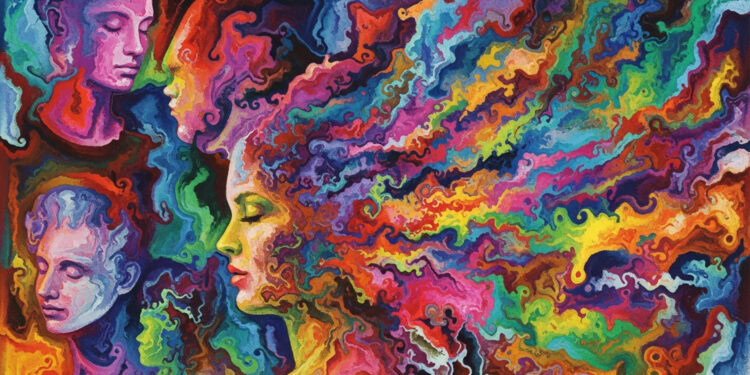
Professional artists who painted under the influence of LSD produced markedly more abstract works than they did before taking the drug, according to a new reanalysis of archived mid-century artworks published in Psychology of Aesthetics, Creativity, and the Arts. At the same time, blind evaluations by art experts detected no meaningful boost in the paintings’ overall creativity or aesthetic appeal, and no reliable drop in technical skill. The findings indicate that while psychedelic experiences can shift an artist’s visual style toward abstraction, they do not necessarily make the finished work more creative.
Lysergic acid diethylamide, commonly known as LSD, is a potent hallucinogenic substance that alters visual perception, emotion, and thought primarily by stimulating specific serotonin receptors in the brain. Alongside renewed clinical interest in psychedelic substances over the past two decades, anecdotal accounts from technology workplaces and visual arts communities have popularized the claim that taking LSD in either tiny microdoses or full hallucinogenic amounts can unlock artistic breakthroughs. Yet subjective impressions during a drug experience can be misleading, making it difficult to tell whether a substance genuinely improves creative work or merely makes ideas feel deeper in the moment.
In psychological science, creativity is typically defined as the ability to produce something that is both original and fitting or effective for its context. Reaching that balance requires two complementary modes of thinking: divergent thinking, which involves loosening mental filters to generate many unusual ideas, and convergent thinking, which involves focused attention to evaluate, refine, and execute the best options. Neuroimaging research indicates that psychedelics temporarily disrupt communication across brain networks responsible for self-focused thought and executive control, a shift that theoretical models suggest may encourage free-flowing associations while interfering with deliberate evaluation.
Controlled studies have largely echoed that distinction rather than confirming popular claims of an all-purpose creative boost. For instance, a 2023 meta-analysis comparing 12 creativity-enhancement methods in adults found that cognitive-manipulation drugs were the least effective option and essentially ineffective at boosting creativity, whereas non-drug approaches such as structured training courses, meditation, and cultural exposure produced meaningful gains.
Don’t miss the next big psychology finding
Every morning, PsyPost sends a short briefing on the most interesting new peer-reviewed research in psychology and neuroscience.
Similarly, a 2022 double-blind, placebo-controlled experiment with 24 healthy volunteers found that a low 50-microgram dose of LSD increased novel associations and symbolic thinking on laboratory tasks while reducing convergent thinking and practical usefulness. Even so, a 2022 integrative review of 11 psychedelic creativity studies pointed out that nearly all modern trials tested brief puzzle-like thinking exercises rather than evaluating finished works of art.
To examine how LSD relates to finished visual art, study authors Mathilde Firmin and Baptiste Barbot of the Psychological Sciences Research Institute at UCLouvain in Belgium, with Barbot also affiliated with the Child Study Center at Yale University, conducted a new reanalysis with colleagues using rare mid-century archival materials.
“Research on psychedelics has focused primarily on their therapeutic potential, particularly for alleviating depression and anxiety,” Firmin and Barbot told PsyPost. “Far less attention has been paid to their potential to enhance creativity, and almost none to the creative product itself, such as artworks. Our study set out to address this gap in the literature and offer a more modern perspective on the subject. We also had a unique opportunity to revisit a historical dataset from the 1950s using modern scientific methods and knowledge, reviving Oscar Janiger’s rich collection of artworks from professional artists.”
That historical collection originated with psychiatrist Oscar Janiger, who administered LSD to more than 900 adults in Los Angeles between 1954 and 1962 to document the subjective effects of the drug. As part of that broader project, Janiger invited 60 established professional artists into a naturalistic studio stocked with drawing, painting, and sculpting supplies, asking them to create artworks before taking LSD and again while under its influence. Participants were often encouraged to depict a Hopi kachina doll, a traditional carved figure, though Janiger gave them freedom to choose their own media and subjects so the creative process would feel authentic.
Although Janiger and a colleague published an initial assessment of 250 paintings from 20 of those artists in 1989, reporting that the LSD works looked more abstract, aesthetically pleasing, and creative despite appearing more fragmented, that early report had notable methodological flaws. The paintings had been handpicked by the researchers rather than sampled systematically, and all ratings came from a single college art professor who knew the purpose of the project. Firmin, Barbot, and their team hypothesized that under rigorous modern testing, paintings made during acute LSD intoxication would score higher in creativity, aesthetic appeal, and abstraction, while scoring lower in technical precision.
Working from archival materials made available by Oscar Janiger’s son, study co-author Robert Janiger, the researchers photographed and cross-referenced the collection of 250 artworks against original study records to confirm who created each piece and when it was made relative to dosing. Because 110 pieces lacked verified records of the artist’s identity, production date, or timing relative to LSD administration, those works were excluded from the reanalysis. The final dataset comprised 140 verified artworks created by 20 experienced professional artists, six of whom remained anonymous in the surviving files, including 33 baseline pieces made before taking LSD and 107 pieces produced during the drug’s acute effects.
According to the original study records, every participating artist first passed a medical and psychiatric screening to rule out severe personality disorders as well as heart, liver, or kidney conditions. After completing an average of roughly two baseline artworks (ranging from one to six pieces), each artist received a standardized moderate-to-high dose of LSD calibrated to body weight at 2.5 micrograms per kilogram, and began creating new art roughly an hour later. Working with materials such as oil paint, watercolors, tempera, pastels, pen and ink, and graphite on paper, canvas, or cardboard, artists produced an average of nearly six works during the LSD session (ranging from one to 24 pieces), and later wrote reflections once the drug wore off and again 30 days afterward.
To rescore the 140 digitized, untitled artworks, the researchers recruited six judges from the United States, the United Kingdom, and Belgium: four specialists with more than 10 years of experience in the art field and extensive experience rating art, plus two quasi-experts, consisting of a doctoral student in art history and a formally trained artist with 35 years of professional design and creative experience. The panel used an online adaptation of the Consensual Assessment Technique, an established method in which knowledgeable judges rely on their own subjective understanding of a domain to evaluate creative products.
Each judge independently rated every randomly ordered image on a 7-point scale across four separate criteria: creativity, aesthetic appeal, technical quality, and level of abstraction, with no information about the study’s purpose, the involvement of LSD, or whether a piece was created before or during the drug session. After combining the 3,360 individual ratings into consensus scores using a statistical model that adjusts for how strictly or leniently individual judges use the scale, the researchers capped one extreme creativity score at three standard deviations from the average so a single outlier would not skew the results. All underlying data and analytical code were posted publicly on the Open Science Framework, and the team fitted linear mixed-effects models to account for artists producing multiple pieces within a single session.
Preliminary checks measured interrater consistency on a 0-to-1 scale, where standard guidelines treat values from .50 to .75 as moderate, .75 to .90 as good, and above .90 as excellent. Consistency among the six judges was moderate to good for aesthetic appeal (.71), creativity (.72), and technical quality (.79), and excellent for abstraction (.92). On the resulting standardized consensus scale, where scores are centered around zero and one unit equals a standard deviation, creativity, aesthetic appeal, and technical quality were strongly positively correlated with one another, whereas abstraction varied mostly independently and showed mild negative associations with the other three traits.
When comparing artworks created before and during LSD intoxication, abstraction was the only dimension that changed reliably, climbing by 0.80 points on the standardized consensus scale, a large effect size reflecting a shift away from literal portraits and kachina dolls toward nonrepresentational shapes, colors, and symbols. Differences between pre-LSD and acute-LSD paintings were not statistically significant for creativity, aesthetic appeal, or technical quality, and a secondary check averaging scores by artist across sessions (using a repeated-measures analysis of variance) reached the same conclusion. Although a separate check excluding the two quasi-experts showed a small, marginal uptick in creativity, dropping those two judges also lowered interrater consistency for creativity from .72 to .60, meaning the uptick came from a less reliable rating pool.
“The increase in abstraction was large in size, meaning the shift toward more abstract artworks after LSD was substantial and clearly detectable by raters,” the researchers explained. “For creativity, aesthetic appeal, and technical quality, effects were negligible to very small in size (although going in the expected direction), but with no statistically significant differences between pre-LSD and acute LSD artworks. It is possible that our limited sample size prevented us from detecting effects of smaller magnitude.”
Those null findings stand in direct contrast to Janiger’s 1989 report on the same broader archive, highlighting how blind evaluation by multiple independent judges can alter conclusions drawn from historical experiments.
“Our findings differ from Janiger’s original work, which reported higher creativity in artworks made under LSD,” Firmin and Barbot said. “A key difference is that the original study relied on a single rater based on artistic productions likely selected a priori by the researcher, whereas we used blind ratings from six raters with the Consensual Assessment Technique, a more rigorous method and a selection of artistic productions picked ‘at random.’ This shows how historical data can gain new value when re-examined with modern methods.”
To make sense of why LSD did not translate into higher creativity ratings, the authors point to how the drug pulls different stages of creative thought in opposite directions. Prior research has found that even a low 50-microgram dose can impair focus and practical utility, and the authors note that the 2.5-microgram-per-kilogram dose used in Janiger’s sessions falls in a normal-to-high range that may stimulate loose idea generation while hindering the convergent evaluation needed to develop and finish a cohesive painting.
Psychedelics also tend to heighten feelings of personal meaning; artists in Janiger’s sessions expressed wonder as colors flowed from the brush onto the canvas, and one participant wrote in a follow-up report that LSD had intensified their creative process, suggesting the drug may elevate subjective inspiration without improving objective quality in the eyes of outside judges.
This gap between subjective inspiration and objective quality aligns with a 2021 placebo-controlled neuroimaging study, which found that psilocybin impaired acute performance on cognitive creativity tests even as volunteers felt more insightful. By contrast, a systematic review and meta-analysis of classic psychedelics and MDMA suggested tentative post-acute gains on cognitive creativity tests more than 24 hours after dosing. Both earlier findings, however, rest on laboratory problem-solving tasks rather than expert ratings of professional artists’ paintings created under the direct influence of LSD.
For aesthetic appeal, the researchers suggest that the stylistic shift from representational kachina dolls and self-portraits before LSD to abstract imagery during the trip may have complicated comparisons, since personal preference for an artistic style strongly shapes beauty ratings. Abstract art also tends to provoke wider disagreement among viewers and depends heavily on historical and contextual cues that were stripped from these digitized, untitled images. Together with possible shifts in taste between mid-century California art circles and contemporary judges, wider dispersion in how the six raters scored abstract pieces may have made subtle differences in aesthetic appeal harder to detect.
To account for the pronounced shift toward abstraction, the authors offer two complementary possibilities. One is that the altered state of consciousness induced by LSD pulls an artist’s attention away from precise, literal details toward raw, free-flowing visual elements, consistent with follow-up notes in which participants described losing interest in formal structure and becoming absorbed in color alone. A second possibility is that artists turned to abstract and symbolic forms intentionally as a way to depict the geometric patterns, shifting shapes, heightened colors, and intense emotions of their visual hallucinations.
As for technical execution, anecdotal notes showed that intoxication still posed practical hurdles for some participants, including one artist who labeled a work as a picture of a man trying and failing to draw the kachina doll. Even so, overall technical quality ratings across the sample held steady during the LSD sessions.
“We expected several changes after LSD, but the decline in technical quality was the one we expected most, since skill is widely assumed to suffer under the influence of psychoactive substances,” Firmin and Barbot noted. “Instead, we found no reliable difference in technical quality before and after LSD, which was quite surprising. However, artistic expertise may play a role here, since the participants were established artists. Perhaps their expert technical skills could help ‘compensate’ for the otherwise detrimental effect of LSD on technicality. A study with non-expert artists would be worth doing.”
There are a few things to keep in mind when interpreting these findings. Because every participant knew they had received LSD and completed their baseline pieces first, the design cannot separate the drug’s pharmacological action from participants’ expectations or the natural progression of warming up during a studio session, and results from established professionals may not extend to everyday creative activities among non-artists.
“There is a general belief that LSD improves creativity (e.g., psychedelic resurgence movement),” the researchers cautioned. “Although our study did not detect a significant effect of LSD on the creativity of professional artwork, we cannot conclude that LSD has no effect on creativity. We found no significant difference in creativity before and after LSD, but our sample was small (20 artists, 140 paintings), which may have limited our ability to detect effects. The study also had no placebo group, so we describe LSD as linked to greater abstraction rather than as its proven cause.”
Working with mid-century archives introduced several additional constraints. Because artists typically completed only one or two works before taking LSD compared with a much larger set during the drug session, those sparse pre-LSD samples may offer less reliable estimates of each artist’s baseline quality. Excluding 110 imperfectly documented artworks further shrank the sample, surviving files lacked exact timestamps and verified individual dosage records (although there was no reason to believe sessions departed from Janiger’s standard protocol), and evaluating digitized photographs may have obscured surface texture, luminosity, and mid-century California art conventions.
“Because this was a re-analysis of historical data with inherent methodological limitations (e.g., no placebo group), more modern, placebo-controlled research is needed,” the researchers emphasized.
“In general, studies of this kind are difficult to conduct today because the risk-benefit ratio of administering LSD to investigate artistic creativity, or creativity more broadly, is often considered unfavorable by ethical review boards,” Firmin and Barbot pointed out. “As a result, undertaking a direct follow-up study would be challenging. The dataset examined here is therefore unique, and we believe that, despite its limitations, archival research of this nature can provide valuable insights into questions that would be difficult, if not impossible, to address through contemporary data collection.”
Looking ahead, the authors suggest that researchers could examine remaining archival works from nonprofessional participants or conduct longitudinal studies tracking whether artists draw lasting inspiration from past psychedelic experiences once the drug has worn off. They also propose using immersive virtual reality to simulate hallucinatory visual environments while participants draw or paint, offering a safe, controlled way to test whether altered perceptual experiences can shift artistic style without administering psychoactive substances.
The study, “Creativity Under LSD: A Reanalysis of Oscar Janiger’s LSD Studies Among Professional Artists,” was authored by Mathilde Firmin, Clément Laloux, Robert Janiger, and Baptiste Barbot.
