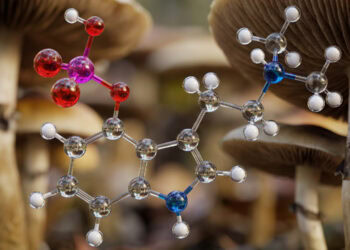
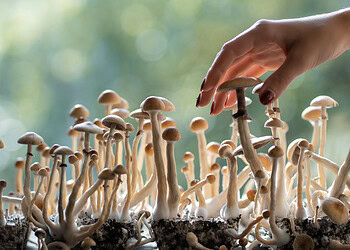
The use of psilocybin, a hallucinogenic substance found in some “magic” mushrooms, has stronger connection to how people feel about nature compared to the use of other psychedelic drugs, according to new research published in the Journal of Psychopharmacology.
Research has found that the use of classic psychedelic drugs is positively associated with people’s sense of connectedness with the natural environment and even objective knowledge about climate change issues. While much of this research is correlational, there is some preliminary evidence of a causal link between psychedelic use and nature relatedness.
Classic psychedelics are a group of psychoactive substances that are known for producing profound alterations in perception, thought, and emotion. They are sometimes referred to as “serotonergic psychedelics” because they primarily act on the serotonin system in the brain. Examples of classic psychedelics include LSD (lysergic acid diethylamide), psilocybin (found in magic mushrooms), and DMT (dimethyltryptamine).
But different types of classic psychedelics appear to have different subjective effects, and previous studies did not typically take this into account. So do all psychedelic drugs boost nature relatedness, or just particular ones? The authors behind the new study sought to systematically investigate this question.
“My interest in this topic and reason for initiating the research collaboration was seeing a presentation delivered by paper co-author David Luke at psychedelic conference Breaking Convention in 2015 as part of an ecodelic symposium I was also a part of,” said independent researcher Sam Gandy, who collaborated with the Centre for Psychedelic Research at Imperial College London for the current study.
“David presented findings from a survey study assessing the effect of different psychedelic substances on people’s self-reported connection to nature and ecological concern. In his sample, psilocybin mushrooms were top of the pile – I was interested to know whether this was a quirk of his dataset, or a broader association that may apply.”
For their new study, the researchers reanalyzed data from five previous studies that had assessed the link between experience with various psychoactive substances and nature relatedness. They found that, among people who had experience with a variety of psychedelic substances, only previous use of psilocybin reliably predicted nature relatedness.
“When assessing past use of the various classical psychedelics (following the combined reanalysis of five independent datasets totaling 3817 participants), only use of psilocybin mushrooms emerged as a reliable predictor of nature relatedness, in addition to the three subdimensions that comprise it,” Gandy told PsyPost.
The three subdimensions that comprise nature relatedness are the individual’s sense of self and identity in relation to nature (e.g. “My relationship to nature is an important part of who I am”), the individual’s personal experiences with nature (e.g., “My ideal vacation spot would be a remote, wilderness area”), and the individual’s attitudes and values towards the natural environment.
When examining those who had experience with psilocybin but none of the other psychedelic drugs, the researchers found that more frequent psilocybin use predicted higher levels of nature relatedness. But this was not the case for those who only had experience with LSD.
“In other words: greater experience with psilocybin predicts more nature relatedness compared to users of other substances (thereby accounting for shared personality traits amongst those users), as well as to non-users,” explained co-author Matthias Forstmann.
“These findings suggest that psilocybin may hold particular promise among the psychedelics as an agent that can facilitate shifts in people’s relationships with nature, and this in turn could have important implications for mental health and well-being,” Gandy said.
But the study, like all research, includes some caveats. The study analyzed correlational data about lifetime experience with different psychedelic substances. “These were the only variables that were consistently assessed in all of the data sets, allowing us to run a combined analysis,” Forstmann explained.
“Results were obtained via a retrospective survey study design, and there is a need for more elaborate study designs moving forward using a prospective, double-blind, placebo-controlled methodologies to investigate potential causality beyond a correlative association,” Gandy said. “Further work should also seek to elucidate why psilocybin appears to have a more reliable association with nature relatedness, and studies could investigate differences in subjective and objective effects of various psychedelics in otherwise identical settings.”
“Settings could also be manipulated where the psychedelic experience occurs (e.g., indoors versus outdoors) while otherwise running in parallel to shed more light on how nature-based settings may affect nature relatedness,” the researcher explained. “More precise assessment of participant intentions, motivations, expectations and desires would be worthwhile to investigate whether these might influence the effects of different psychedelics with regard to both their acute and longer-term effects on their users.”
“Another study of a Brazilian sample reported a stronger association between ayahuasca/DMT use and nature relatedness than was reported for psilocybin, hinting at potential cultural differences,” Gandy added. “Perhaps differences in phenomenology or pharmacodynamics between different psychedelics could be partly responsible – more work is warranted here to help shed light on this.”
“These study findings may contribute to the development of clinical interventions, hint at the intricate effect of different psychedelics, and highlight the need to further investigate how contextual and interpersonal factors may interact with a psychedelic to potentially yield sustained shifts in cognition and behavior.”
The study, “Among psychedelic-experienced users, only past use of psilocybin reliably predicts nature relatedness“, was authored by Matthias Forstmann, Hannes S Kettner, Christina Sagioglou, Alexander Irvine, Sam Gandy, Robin L Carhart-Harris, and David Luke.