Subscribe
The latest psychology and neuroscience discoveries.
My Account
  • Mental Health
  • Social Psychology
  • Cognitive Science
  • Neuroscience
  • About
No Result
View All Result
PsyPost
PsyPost
No Result
View All Result
Home Exclusive Mental Health

Repeatedly viewing underweight women doesn’t alter women’s body satisfaction

by Eric W. Dolan
May 6, 2020
in Mental Health, Social Psychology
Share on TwitterShare on Facebook

New research suggests that repeatedly viewing underweight or overweight bodies can influence women’s perceptions of what a “normal” body looks like, but does not appear to have much of an impact on their own body satisfaction. The findings have been published in Royal Society Open Science.

“As a clinician I work with people with eating disorders, so I want to understand more about how to prevent and treat them,” said study author Helen Bould, a consultant senior lecturer in Child and Adolescent Psychiatry at the University of Bristol and Gloucestershire Health and Care NHS Foundation Trust.

“It’s possible to change how women see others’ body size by showing them bodies of different sizes — I wanted to see if you can also change how women see their own size, and how satisfied they are with their size. If it worked, maybe we would have something we could try out as part of eating disorders treatment, or maybe it could help us use images in the media better to prevent eating disorders.”

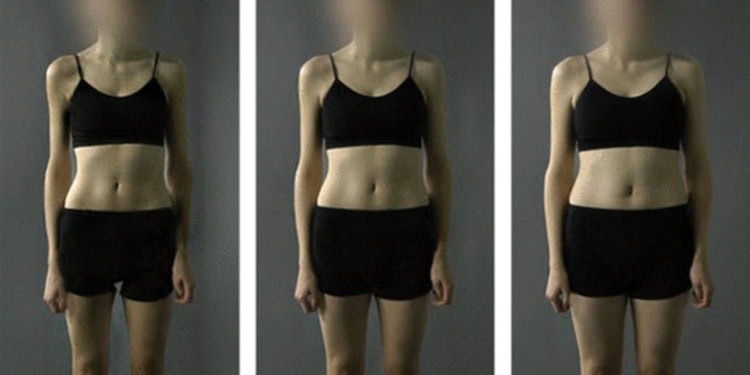
In the study, 93 women between the ages of 18 and 30 years were randomized to one of the three groups. One group repeatedly viewed photographs of overweight women, one group viewed photographs of underweight women, and another viewed photographs of women who were neither over- nor underweight. To ensure that participants paid attention, the participants were required to indicate whether the photograph had the same identity as the one presented immediately before, or a different identity.

The participants completed this task twice a day for a week. At the end of the week, they then competed measures of their perception of body sizes.

The researchers found evidence that repeated exposure to different body weights altered perceptions of the size of other women’s bodies. Women who repeatedly viewed underweight bodies ended up perceiving fewer bodies as being underweight and more bodies being overweight. Women who repeatedly viewed overweight bodies, on the other hand, showed the opposite pattern.

But the photographs did not appear to impact the women’s perception of their own body size or their body satisfaction.

However, there was some evidence that photographs influenced their ideal body size. The participants were asked to alter the weight, bust, waist and hip sizes of a computer avatar to indicate the size and shape they would most like to resemble. Those exposed to the underweight images tended to create thinner ideal bodies.

Google News Preferences Add PsyPost to your preferred sources

“Repeated viewing of images of different sized bodies changes how women view the size of other images of bodies. We didn’t find that it reliably changed their view of their own size, but if you repeatedly show them images of smaller women, their ideal body size gets smaller,” Bould told PsyPost.

“We had to make a lot of decisions about the trial design, like how big or small to make the different images, and to use manipulated images of real women, rather than airbrushed magazine images. So there are still questions to answer about the effects of repeated exposure to idealised photos, for example on Instagram. We also ran our trial in healthy women, not in women with an eating disorder — so future studies in both in a patient population, and in men, would be useful.”

But why did the study only include women to begin with? The researchers have a simple answer. “We chose to study women first as eating disorders are 5-10 times more frequent in women than men,” Bould explained.

The study, “Does repeatedly viewing overweight versus underweight images change perception of and satisfaction with own body size?” was authored by Helen Bould, Katharine Noonan, Ian Penton-Voak, Andy Skinner, Marcus R. Munafò, Rebecca J. Park, Matthew R. Broome and Catherine J. Harmer.

Previous Post

Heroes tend to downplay their actions and new psychology research might explain why

Next Post

Home confinement during COVID-19 puts children at risk for symptoms of anxiety and depression, study suggests

RELATED

Trigger warning sign comic style, caution alert notice, bold red and yellow warning graphic for sensitive content, online psychology news, mental health awareness, psychological triggers, PsyPost psychology news website, mental health topic warning, pop art warning sign, expressive warning graphic for psychological topics, relevant for mental health and psychology discussions, eye-catching digital poster.
Mental Health

How the wording of a trigger warning changes our psychological response

March 6, 2026
Emotion dysregulation helps explain the link between overprotective parenting and social anxiety
Mental Health

Dating and breakups take a heavy emotional toll on adolescent mental health

March 6, 2026
Study sheds light on the truth behind the “deceptive stability” of abortion attitudes
Social Psychology

Abortion stigma persists at moderate levels in high-income countries

March 6, 2026
Brain scans reveal two distinct physical subtypes of ADHD
ADHD Research News

Brain scans reveal two distinct physical subtypes of ADHD

March 6, 2026
Employees who feel attractive are more likely to share ideas at work
Attractiveness

Employees who feel attractive are more likely to share ideas at work

March 6, 2026
Stimulant medications normalize brain structure in children with ADHD, study suggests
ADHD Research News

Long-term ADHD medication use does not appear to permanently alter the developing brain

March 5, 2026
Pro-environmental behavior is exaggerated on self-report questionnaires, particularly among those with stronger environmentalist identity
Climate

Conservatives underestimate the environmental impact of sustainable behaviors compared to liberals

March 5, 2026
Common left-right political scale masks anti-establishment views at the center
Political Psychology

American issue polarization surged after 2008 as the left moved further left

March 5, 2026

STAY CONNECTED

LATEST

How the wording of a trigger warning changes our psychological response

Dating and breakups take a heavy emotional toll on adolescent mental health

Abortion stigma persists at moderate levels in high-income countries

Brain scans reveal two distinct physical subtypes of ADHD

Employees who feel attractive are more likely to share ideas at work

New psychology research reveals that wisdom acts as a moral compass for creative thinking

Long-term ADHD medication use does not appear to permanently alter the developing brain

Using cannabis to cut back on alcohol? Your working memory might dictate if it works

PsyPost is a psychology and neuroscience news website dedicated to reporting the latest research on human behavior, cognition, and society. (READ MORE...)

  • Mental Health
  • Neuroimaging
  • Personality Psychology
  • Social Psychology
  • Artificial Intelligence
  • Cognitive Science
  • Psychopharmacology
  • Contact us
  • Disclaimer
  • Privacy policy
  • Terms and conditions
  • Do not sell my personal information

(c) PsyPost Media Inc

Welcome Back!

Login to your account below

Forgotten Password?

Retrieve your password

Please enter your username or email address to reset your password.

Log In

Add New Playlist

Subscribe
  • My Account
  • Cognitive Science Research
  • Mental Health Research
  • Social Psychology Research
  • Drug Research
  • Relationship Research
  • About PsyPost
  • Contact
  • Privacy Policy

(c) PsyPost Media Inc