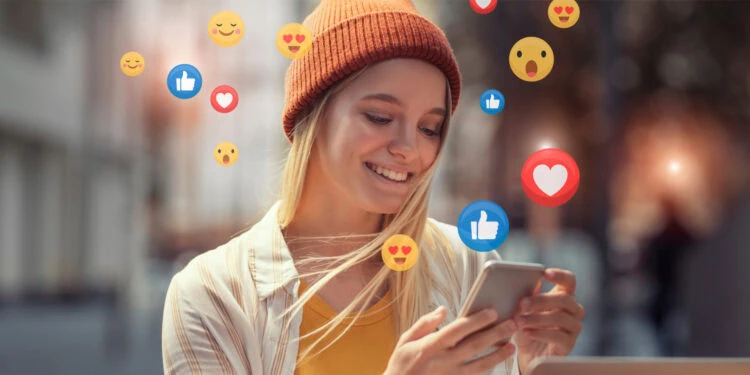
When people read a text message containing a smiling face emoji, their brains may begin registering its emotional tone before their eyes even look directly at it, according to new eye-tracking research published in Quarterly Journal of Experimental Psychology. The experiment indicates that an upcoming positive face emoji is associated with readers pausing slightly longer on the preceding word than a neutral face emoji is, while also finishing the overall sentence slightly faster. Together, the findings provide evidence that readers take in emotional symbols alongside neighboring words in parallel rather than processing each item strictly one at a time.
Emojis are small pictorial symbols depicting faces, gestures, objects, and animals that people insert into digital messages to convey emotion and tone, serving a role similar to facial expressions in spoken conversation. People tend to be remarkably quick at reading these tiny faces: an earlier emotion-recognition experiment found that participants identified emotions 73 milliseconds faster and more accurately from emojis than from photographs of real human faces, with happy expressions recognized fastest of all.
Matching symbols can also shape how an entire message lands, as an earlier study of social media posts indicated that tweets paired with an emotionally fitting emoji were judged easier to understand and more believable than tweets with mismatched emojis or none at all.
Beyond overall message impressions, psychologists use high-speed eye-tracking cameras to examine how emojis alter the split-second mechanics of reading. As the eyes move across a line of text, sharp central vision, known as foveal vision, focuses on the word currently being read, while the surrounding area of near-peripheral vision, called the parafovea, previews upcoming characters just to the right.
Don’t miss the next big psychology finding
Every morning, PsyPost sends a short briefing on the most interesting new peer-reviewed research in psychology and neuroscience.
When a word or symbol in that parafoveal preview alters how long the eyes dwell on the current word, researchers call it a parafoveal-on-foveal effect. Such effects sit at the center of a longstanding debate between serial reading models, which hold that people process the meaning of only one word at a time, and parallel reading models, which propose that attention spans several adjacent items simultaneously.
Recent eye-tracking experiments have shown that object emojis placed right after a matching noun, such as a wine glass symbol following the word “wine,” can speed up reading of that preceding word from parafoveal vision. Face emojis, however, do not stand in for a single concrete noun and instead carry broader social and emotional shades of meaning, with survey studies suggesting that even ostensibly neutral faces are sometimes read as slightly cold or negative. Whether the facial expression on an emoji placed in the middle of an everyday neutral sentence alters how readers process the words right before and after it had not yet been tested.
Whether a cheerful face symbol also gives readers a head start on surrounding words during natural reading was another open question, after 2025 and 2026 single-word studies by the same researchers indicated a positivity bias in which smiling emojis sped up recognition of isolated neutral words. The new research, led by Demian Stoianov as part of his doctoral work at Macquarie University and the University of Groningen, examined how facial expressions shape sentence reading.
“In our earlier experiments, we showed people an emoji and measured how quickly and accurately they could decide whether a string of letters was a real word,” Stoianov, now a postdoctoral researcher in the Forkosh Lab in the Department of Cognitive Science at the Hebrew University of Jerusalem, told PsyPost. “The emoji’s emotional tone could influence their performance even though it gave them no clue to the correct answer. We wanted to know whether that influence would also show up in people’s eye movements as they read a whole sentence at their own pace. The earlier studies appeared in Cognition and Emotion (2025) and Scientific Reports (2026).”
To test this, the researchers first created 100 emotionally neutral sentences, each consisting of two independent clauses separated in the middle by a dash (for example, pairing “Did you change your hair” with “something is different”). The words directly before and after the dash were matched on length, frequency in English, spelling similarity to other words, and emotional tone. An independent prescreening group of 34 Australian university students, with an average age of 21.5, rated each dash-separated sentence online on a 5-point scale from very negative to very positive, allowing the team to select the 64 most consistently neutral sentences, which averaged about 11 words in length.
The researchers also selected 64 Apple face emojis, consisting of 32 positive and 32 neutral faces validated in standardized emoji databases, and adjusted them for uniform pixel size and brightness. Each of the 64 sentences was paired with one plausible positive face and one plausible neutral face, producing 128 versions divided into two lists so that each reader saw 64 sentences, half positive and half neutral, without seeing any sentence or emoji twice.
Fifty-one native English-speaking undergraduate psychology students at Macquarie University were recruited, with one excluded due to calibration issues and horizontal drift, leaving the preregistered final sample of 50 participants (36 women and 14 men, aged 18 to 34, with an average age of 19.5). The study’s sample size, hypotheses, and primary analyses were preregistered, and all materials and data were posted publicly on the Open Science Framework. Sitting 104 centimeters from a desktop monitor in a head-stabilized setup, participants silently read the single-line sentences with both eyes while an infrared eye tracker recorded movements 1,000 times per second, with data from the right eye analyzed. After finishing each sentence, participants rated the sentiment of either the sentence, on half of the trials, or the emoji, on the other half, on the same 5-point scale.
The team tracked both early eye-movement measures, which reflect a reader’s initial pass over a word, and late measures, which reflect rereading and sentence integration. Early measures included first-fixation duration (how long the very first glance on a word lasted), single-fixation duration (how long the glance lasted when a word was fixated only once before moving on), and gaze duration (the combined time of all consecutive initial glances on a word before leaving it). Late measures included total reading time on a word, the probability of looking back at it after leaving, and total dwell time across the full sentence.
In everyday digital communication, positive face emojis tend to be more familiar, higher in emotional arousal, less visually complex, and slightly different in how unambiguous their meaning is compared to neutral faces. To isolate the effect of positive versus neutral emotion, the statistical models adjusted for those four emoji characteristics.
When participants looked directly at the emoji itself, the expected positivity advantage emerged: positive face emojis drew shorter total reading times than neutral ones, averaging 298 versus 362 milliseconds. Positive faces also prompted fewer backward glances and shorter early fixation times, with initial glances on the emoji averaging 208 versus 226 milliseconds and first-pass gaze durations showing a similar pattern.
On the word immediately preceding the emoji, however, the pattern went in the opposite direction. Across all three early eye-tracking measures, readers paused slightly longer on the preceding word when the upcoming face in parafoveal vision was positive rather than neutral; for example, single-fixation durations averaged 196 milliseconds before a positive face compared to 192 milliseconds before a neutral face, with first-fixation and gaze durations showing similar small, statistically reliable increases in the transformed models. Late measures on that preceding word, including total reading time and backward glances, were not statistically significant.
Notably, detecting any valence effect on the preceding word depended on accounting for emoji familiarity, arousal, visual complexity, and ambiguity: in parallel models that omitted those four adjustments, differences between positive and neutral emojis were not statistically significant across the eye-tracking measures. Even with those adjustments in place, the authors describe their interpretation of the brief pause as tentative given the modest raw millisecond differences, suggesting that a cheerful face in peripheral vision may capture attention or briefly compete for mental resources while the reader finishes the current word, similar to patterns reported for emotional words in character-based scripts like Chinese.
“Our eyes sometimes land just short of where we aim them,” Stoianov explained. “We wondered whether readers who appeared to be looking at the end of a word had actually been aiming for the emoji beside it. Even after we set aside glances that landed on the word’s final letter or in the space before the emoji, we still saw the difference between positive and neutral faces.”
During initial data cleaning, very brief nearby glances were merged (about 4 percent of the data), while trials with blinks in or right next to the target region or fixations longer than 1,200 milliseconds were removed, excluding 25 percent of trials. As context for that data loss, the researchers noted that earlier mid-sentence emoji studies by members of the same team had documented high emoji-skipping rates of roughly 56 to 66 percent, depending on whether comprehension questions targeted the symbols. In their non-preregistered follow-up check for mislocated fixations, mapping eye landings character by character across a 10-space window around the emoji and incorporating adjacent blank spaces reduced data removal to about 6 percent, consistent with the view that narrow boundaries around a small symbol can inflate apparent skipping and missing data when glances land slightly to the side.
Although glances did cluster within two character positions of the emoji, breaking single-fixation times down by distance showed that the valence difference held specifically at a middle distance of 4 to 10 characters before the emoji rather than within 1 to 3 characters or beyond 10 characters. Rerunning the models after excluding fixations on the final letter of the preceding word and the space before the emoji still yielded longer first-fixation, single-fixation, and gaze durations before positive faces (with single fixations averaging 196 versus 193 milliseconds), indicating that the pause was not merely an eye-aiming artifact and supporting parallel-processing models of reading.
On the word immediately following the emoji, by contrast, differences between positive and neutral face emojis were not statistically significant across any early or late measure, including first-fixation duration, single-fixation duration, gaze duration, total reading time, and backward regressions. Greater visual complexity of the emoji was associated with slightly longer initial glances on the next word and higher arousal with shorter total reading time in the initial models, though neither relationship remained statistically significant in the character-level reanalysis.
“In our earlier experiments with words shown in isolation, a positive emoji helped people recognize the word that came next,” Stoianov said. “We expected a similar benefit here, yet we found no reliable difference on the word immediately after the emoji. One possibility is that a face between two clauses acts a little like punctuation, giving readers a moment to wrap up one thought before moving on to the next.”
Unlike studies that position an emoji at the very start of a sentence, the authors propose that ongoing grammar and meaning integration mid-sentence, combined with that clause-ending wrap-up process, may mute any emotional priming boost on the next word. Across the full sentence, however, participants finished reading trials with a positive face emoji faster overall than those with a neutral face emoji, averaging 2,523 milliseconds compared to 2,585 milliseconds, with higher emoji arousal also linked to faster sentence reading.
“The first glance at the word before the emoji lasted on average a few milliseconds longer when a positive face was coming up, and across a whole sentence, readers finished about 60 milliseconds sooner with a positive face than with a neutral one,” Stoianov noted. “These differences were statistically reliable and consistent, and we tested one emoji per sentence, so these small effects may accumulate over a conversation.”
Exploratory sentiment ratings collected after each trial aligned with those reading shifts, with participants rating positive emojis higher than neutral ones on the 5-point scale (averaging 3.1 versus 2.3). Readers also judged sentences containing positive faces more positively than the same sentences paired with neutral faces (2.9 versus 2.3), consistent with the authors’ note that some nominally neutral emojis may be interpreted as slightly negative.
Comparing those scores against the independent prescreening group’s ratings of the dash-separated versions without emojis showed that the plain dashed sentences averaged 3.0, edging out the positive-emoji versions (2.9) and scoring well above the neutral-emoji versions, which the authors suggest may indicate that adding emojis can sometimes make a plain statement come across as less sincere.
“You may start picking up on an emoji’s emotional tone before you look directly at it, as we found that readers’ eyes lingered a little longer on the word just before a positive face than before a neutral one,” Stoianov pointed out. “Also, even a face classed as neutral could give an otherwise matter-of-fact message a slightly negative tone.”
There are a few things to keep in mind when interpreting these findings. The experiment tested only emotionally neutral, two-clause sentences read in a laboratory setting, so facial emojis might behave differently inside messages that already carry strong positive, negative, or sarcastic meaning, and the word-level preview effect emerged only after statistically adjusting for familiarity, arousal, visual complexity, and ambiguity. In addition, the eye-tracking session itself did not include plain sentences without emojis, meaning the sentiment comparison against dash-separated text came from two separate groups of readers.
“If you’re wondering whether adding a smile will make a message sound friendlier, it matters what you’re comparing it with,” Stoianov cautioned. “Every sentence in our eye-tracking experiment contained an emoji. In a separate pretest, another group read the same sentences with a dash in place of the emoji. They rated those versions slightly more positively than the readers who saw the versions with a positive face.”
Looking ahead, the authors note that future experiments could systematically vary where emojis appear within a sentence to test how placement and clause boundaries shape subsequent word reading. Expanding beyond smiling and neutral faces to examine negative and high-arousal expressions could also test whether negative facial cues capture peripheral attention just as early.
“We’d like to know whether readers pick up on a frown as early as a smile,” Stoianov added. “One way to test this would be to let readers glimpse either expression while their eyes are still on the preceding word. As their gaze crosses an invisible boundary just before the emoji, the screen would switch to the same final face in both versions. That would let us test whether the expression in that first glimpse changes how long readers linger on the preceding word.”
The study, “The Effect of Positive Emojis on Reading: An Eye-Movement Study,” was authored by Demian Stoianov, Nenagh Kemp, Signy Wegener, and Elisabeth Beyersmann.
