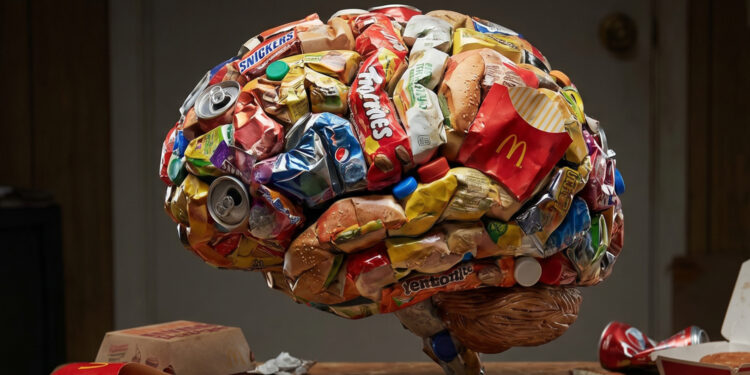
Eating an ultraprocessed meal triggers a substantially higher surge in blood insulin, slightly higher post-meal calorie burning, and a slower shift toward burning carbohydrates compared to a non-ultraprocessed meal with nearly identical nutrients, according to a clinical trial published in Nature Metabolism.
These post-meal metabolic shifts also tracked with how reward-processing areas of the brain reacted to photographs of food, even though volunteers reported liking both types of food equally and bid similar amounts of money for them. Together, the findings indicate that industrial food processing alters how the body and brain respond to a meal through pathways that go beyond calories, fat, sugar, or fiber alone.
From nutrient counts to gut-to-brain reward signals
Under the Nova classification system, which groups foods by the extent and purpose of industrial processing, ultraprocessed foods are factory-manufactured formulations created through multiple physical and chemical transformations. Common manufacturing steps include breaking whole crops down into isolated starches, oils, and proteins, heating ingredients under high pressure through extrusion, and adding flavorings, emulsifiers, or colorings rarely used in home kitchens.
Products in this category account for 55 percent of the calories consumed in the United States, according to federal dietary survey data. Large population studies link heavy intake to obesity, metabolic disease, and cancer, though skeptics argue those risks simply reflect excess calories, fat, and sugar rather than processing itself.
Don’t miss the next big psychology finding
Every morning, PsyPost sends a short briefing on the most interesting new peer-reviewed research in psychology and neuroscience.
Controlled feeding experiments have begun testing whether standard nutrient profiles explain the entire effect of these foods. In a 2019 inpatient clinical trial of 20 adults, volunteers offered two-week menus matched for presented calories, sugar, fat, sodium, and fiber ate about 500 extra calories per day on the ultraprocessed diet and gained weight, though because participants chose their own portions, the food they actually ate still differed in calories and macronutrients.
Neuroscientists have simultaneously examined how modern diets engage the striatum, a cluster of structures deep inside the forebrain that includes the caudate, putamen, and ventral striatum. Together, these regions help govern reward valuation, motivation, and habit learning. In a 2018 neuroimaging study led by senior author Alexandra DiFeliceantonio, people were willing to pay more per calorie for snacks combining fat and carbohydrates than for equally liked foods rich in fat or carbohydrates alone, an effect accompanied by heightened activity in the striatum.
Heavy habitual intake of ultraprocessed foods was also linked to structural differences in the striatum and the appetite-regulating hypothalamus in an observational brain-imaging study of adults, patterns that were related in part to higher body fat and systemic inflammation. At the same time, an experimental neuroimaging study found that drinking an ultraprocessed milkshake did not produce a statistically significant average surge of dopamine in the striatum during consumption.
Rather than acting solely through immediate taste on the tongue, foods also teach the brain their value after a meal through a subconscious process called flavor-nutrient learning. As digested nutrients cross the wall of the upper small intestine, gut sensors send signals to the brain’s reward circuits that become linked over repeated meals with the sights and flavors of those foods. Supporting this gut-to-brain pathway, a 2017 human brain-imaging and metabolism study found that the strength of the body’s metabolic response after drinking sweetened beverages predicted how much participants came to like those flavors and how strongly their striatum reacted to them.
Industrial manufacturing breaks down cellular walls and alters physical food structure, which could change how rapidly nutrients reach sensors in the upper digestive tract. To test whether processing alters post-meal metabolism and brain responses when nutrients are held constant, graduate student Zach Hutelin and senior author Alex DiFeliceantonio, an associate professor at the Fralin Biomedical Research Institute at VTC and in the Department of Human Nutrition, Foods, and Exercise at Virginia Tech, led a controlled trial.
“We have a lot of population-level evidence that ultra-processed foods (UPFs) are linked with poor health outcomes,” DiFeliceantonio told PsyPost. “UPFs also tend to have less fiber, less protein, and more fat and sugar than minimally processed foods.”
“We wanted to ask, if we held these things constant, would there still be a measurable difference in the response to these foods? And could we find a response in the brain that correlates? This would tell us that information about these foods might be processed by the brain differently,” she explained.
Testing matched meals in a metabolic chamber and brain scanner
The clinical trial was registered at ClinicalTrials.gov, and the team posted their underlying metabolic data, neuroimaging scans, and analysis code on public repositories. Data collection ran from June 2023 to December 2025, with the metabolic visits completed by March 2025. The researchers enrolled 57 healthy-weight adults aged 18 to 45, with an average age of 26, 31.6 percent male, and an average BMI of 22.8. Participants’ everyday diets consisted of 54.4 percent ultraprocessed calories, closely matching the 55 percent national average and indicating that their typical eating habits reflected those of U.S. adults generally.
Because the metabolic testing required multiple four-hour morning visits, 32 participants completed both meal sessions in a randomized crossover design, meaning each person ate both test meals on separate mornings in a random order and served as their own control. To reduce the scheduling burden on volunteers, spacing between the two visits was not fixed, ranging from within three days for seven participants to more than four weeks for four participants.
Usable brain-scan data were obtained from 52 participants, including 29 who also had complete metabolic records. The study was prospectively powered at 52 participants for the auction task and 27 for the metabolic comparisons, whereas the 29-person brain-metabolism analysis relied on an ad hoc power calculation calibrated to an unusually strong relationship reported in an earlier sweetened-beverage study.
Before each metabolic visit, participants fasted overnight and entered a whole-room indirect calorimeter, an airtight, climate-controlled chamber that continuously measures the oxygen a person inhales and the carbon dioxide they exhale. From those gas measurements, researchers calculated each volunteer’s metabolic rate, or calories burned per minute, along with their respiratory exchange ratio, which tracks the balance of carbohydrates versus fats the body is burning for fuel.
Volunteers wore wrist and ankle accelerometers to confirm minimal physical movement, while staff drew intravenous blood samples through sealed ports in the chamber wall before the meal and at seven time points up to three hours afterward to measure blood glucose and insulin. After a 50-minute resting baseline, participants were given up to 10 minutes to finish an approximately 300-calorie meal composed entirely of either non-ultraprocessed or ultraprocessed items.
The non-ultraprocessed meal weighed about 156 grams and combined minimally processed staples: hard-boiled eggs, banana, sweetened dried cranberries, cheese, and sea salt. The ultraprocessed meal weighed the same and combined packaged items such as deli-style turkey, instant mashed potatoes, frosted wheat cereal, veggie chips, a chocolate chip cookie, and white bread with peanut butter and jelly, plus 12 grams of water.
Using nutritional software, the team matched the two meals to within 1.6 percent on a dozen nutritional measures, including total calories, macronutrients, dietary fiber, sodium, and glycemic index, which reflects how rapidly a food raises blood sugar. Participants also rated their hunger, fullness, and thirst before and after eating, along with how much they liked and wanted each meal.
In separate sessions, volunteers evaluated photographs of 28 familiar foods, 14 non-ultraprocessed and 14 ultraprocessed, that had been validated in earlier work by the same research team to match on visual features and nutrient content, and from which the two chamber meals were built. On another day, after fasting for three hours so they arrived neither hungry nor full, participants underwent functional magnetic resonance imaging (fMRI), which tracks localized blood flow as a measure of brain activity while they viewed each food image for five seconds.
Inside the scanner, volunteers placed real-money bids from $0 to $5 on each item in a Becker-DeGroot-Marschak auction, an economics task designed so that bidding one’s genuine maximum willingness to pay is the best strategy. Afterward, participants estimated the typical retail price of each food.
Higher insulin spikes and a blunted shift to burning carbohydrates
At the start of the two metabolic visits, resting calorie expenditure, physical movement, fasting blood sugar, fasting insulin, and prior-day calorie intake showed no statistically significant differences between conditions. Participants took an average of 1.5 minutes longer to eat the ultraprocessed meal than the non-ultraprocessed meal, while post-meal ratings of liking, wanting, hunger, fullness, and thirst were not statistically significant between the two meals.
Consistent with the matched glycemic index, the cumulative three-hour blood glucose response did not differ in a statistically significant way between meals, with both peaking at 40 minutes. Even so, blood sugar rose faster after the non-ultraprocessed meal, reaching higher concentrations at 20 minutes, the only individual time point that survived statistical correction. After the ultraprocessed meal, glucose instead trended higher at two and three hours rather than returning to baseline in the same manner.
Despite similar peak and overall blood sugar responses, the ultraprocessed meal produced a markedly larger cumulative surge in blood insulin. Insulin concentrations were comparable through the first 20 minutes, then rose higher after the ultraprocessed meal at 40, 60, 90, and 120 minutes before both conditions returned near baseline at three hours.
Looking at those hormone profiles, DiFeliceantonio singled out that spike: “The insulin result was the most surprising.”
Inside the calorimeter chamber, volunteers burned more total calories over the three hours after eating the ultraprocessed meal, as their metabolic rate declined more slowly after peaking around 40 minutes. Yet their respiratory exchange ratio, reflecting the balance of fuel being burned, was lower after the ultraprocessed meal, with lower carbohydrate burning and higher fat burning. That pattern indicates the ultraprocessed meal blunted the body’s normal post-meal switch from burning fat to burning incoming carbohydrates, even after accounting for how much ultraprocessed food participants ate in everyday life.
“If the meals in the study had a nutrition label, they’d be nearly identical,” DiFeliceantonio said. “What surprised us the most was that we saw any large differences at all. So, a takeaway would be if you are using nutrition labels to think about the effects a food will have on your body, they might not be the whole story, and it’s worth also considering what processing the food might have undergone.”
How fuel burning and food value register in the brain
To test whether post-meal fuel burning tracked with brain reactivity to food cues, the researchers analyzed the subgroup of 29 participants who had usable data from both the chamber visits and the fMRI scan. Across a strict whole-brain search, meal-related differences in peak carbohydrate burning and the closely related fuel-burning balance tracked with activity in the left superior temporal gyrus, a temporal lobe region involved in auditory and multisensory processing that also responds to food sights.
Within a pre-selected mask of the striatum, which carries a lower statistical hurdle than scanning the entire brain, carbohydrate burning was linked to the right caudate and left ventral striatum, with fuel-burning balance showing the same pattern at two spots in the right caudate. Across these regions, participants whose carbohydrate burning was most blunted by the ultraprocessed meal showed stronger brain activity when viewing ultraprocessed food pictures relative to non-ultraprocessed ones, an inverse relationship opposite to earlier studies that scanned people while they tasted sweet drinks rather than viewed photos.
Notably, even though the ultraprocessed meal triggered a steep rise in blood insulin, between-meal differences in peak insulin were not a statistically significant predictor of brain responses to the food images. Differences in peak metabolic rate, fat burning, and blood glucose were not statistically significant predictors either, and adjusting for BMI or shifts in hunger, fullness, and thirst left the results unchanged. In the authors’ interpretation, that contrast suggests carbohydrate burning in particular, rather than insulin or overall calorie expenditure, helps relay nutrient information from the gut to the brain.
For the separate food-valuation analysis, which did not require metabolic chamber data, the researchers examined all 52 scanned volunteers. Behavioral ratings of the 28 food pictures were not statistically significant between categories for liking, familiarity, expected fullness, estimated price, or estimated calories, though participants rated the non-ultraprocessed foods as healthier and reported eating them more often.
After accounting for perceived healthiness and consumption frequency, auction bids did not differ in a statistically significant way between ultraprocessed and non-ultraprocessed items, while overall bid amounts across all foods tracked as expected with activity in classic valuation areas such as the orbitofrontal cortex behind the eyes and the anterior cingulate cortex.
When the researchers compared how brain activity scaled with bid amounts for each category separately, again adjusting for perceived healthiness and consumption frequency, opposing patterns emerged. Across the whole brain, those differences peaked in visual recognition regions along the underside of the brain, specifically the left fusiform gyrus and left lingual gyrus, while a targeted analysis within the pre-selected striatal mask identified matching differences in the right putamen and right caudate.
In all four regions, brain activity climbed with higher bids for non-ultraprocessed foods but fell with higher bids for ultraprocessed foods, a pattern that also held in a follow-up check controlling for image complexity and object size. Testing the reverse contrast, looking for any brain region where activity tracked more positively with bids for ultraprocessed foods than for non-ultraprocessed foods, yielded no statistically significant results either across the whole brain or within the striatum.
What the findings mean for metabolism and food policy
“The most important takeaway from this work to me is that ultra-processing matters,” Filip Morys, a research associate at the Montreal Neurological Institute at McGill University who was not involved in the research, told PsyPost. “There is a lot of criticism of the concept of ultra-processed foods, mainly regarding the fact that those foods are simply high in saturated fats or sugars or simply have more calories and that those differences might mediate the negative effects on health that we are seeing. In other words, what the critics are saying is that ultra-processing as an industrial process does not matter, but it’s all about the macronutrients and calories.”
“But what this paper shows quite convincingly is that even if the foods are extremely well-matched for all of those factors, there are still differences in metabolic and brain responses compared to non-UPFs,” Morys continued. “So, the mere fact that those foods are ultra-processed – might contain some additives or undergo processing in extreme temperatures, etc. – changes how our bodies react to them.”
These findings align with an earlier controlled dietary trial in men, which found that a multi-week ultraprocessed diet increased fat mass, worsened cholesterol and blood pressure, and impaired male reproductive hormones and sperm motility relative to an unprocessed diet, independent of total calories. However, whereas that earlier trial tracked cumulative health changes over several weeks, the new study measured immediate metabolic and brain reactions to a single meal.
In their paper, the Virginia Tech authors suggest that industrial techniques meant to optimize mouthfeel, such as formulating brittle snacks and cereals so they fracture rapidly on the first bite, mix quickly with saliva, and form a homogeneous semi-fluid paste, may alter digestion kinetics and nutrient delivery in the upper gut. They note that an elevated insulin surge alongside similar peak blood glucose and a delayed switch to carbohydrate burning resembles physiological patterns observed in reduced insulin sensitivity and type 2 diabetes.
“The study was not designed to assess chronic outcomes,” DiFeliceantonio noted. “We have a lot of data linking ultraprocessed food intake with poor health outcomes, but we don’t know how these foods exert their effects. This gives us some clues. The insulin response is high, the shift to carbohydrate oxidation is slower, and that might help us understand why they lead to poor metabolic health outcomes.”
Beyond the laboratory, the findings intersect with public debates over federal nutrition policy, where critics sometimes argue that scientists still lack a consistent way to categorize industrially manufactured foods. In nutrition science, researchers routinely score diets using established frameworks such as the Nova system, whereas government regulators have yet to adopt formal criteria for food labels.
Asked what common misconception she hoped to address, DiFeliceantonio pointed to one recurring claim: “The idea that we don’t have a working research definition of ultra-processed foods. We do. What we don’t have is a policy and labeling definition.”
“I am a basic scientist, and my goal is to provide good information so people and policymakers can make informed, evidence-based decisions,” DiFeliceantonio added. “I’m not going to say what should be done or what people should do. However, I think it’s worth noting that a definition of UPF was delayed after food industry involvement and a recent paper in the American Journal of Public Health found that a study was more than twice as likely to defend or promote UPF if an author was industry-funded than if not.”
Caveats, neuroimaging limits, and next steps for research
As with all research, there are some caveats to consider. Although the two test meals contained the same total grams of protein, the protein came from different food sources, such as eggs and cheese versus deli turkey, wheat, and peanuts, which could have contributed to differences in insulin secretion. In addition, the ultraprocessed meal contained industrial additives alongside altered physical food structures, and the team did not directly measure the microscopic cellular matrix beyond total dietary fiber, leaving open which specific aspect of processing drove the metabolic gap.
Prior studies have also found that people eat ultraprocessed foods more rapidly when choosing their own portions, whereas here participants ate the fixed 300-calorie ultraprocessed meal slightly more slowly, though the authors note that a 1.5-minute difference is unlikely to have a meaningful physiological effect.
“What is still missing is which factors exactly – for example, altered food matrix (e.g., cellular structure, physical architecture – think peanuts vs. peanut butter), additives, industrial ingredients – and to what degree make this happen,” Morys said. “I am confident about the metabolic findings, e.g., larger insulin response, metabolic rate, or carbohydrate oxidation, because these are very precise measures and the study design is excellent.”
Greater caution applies to the neuroimaging link between fuel burning and food-cue reactivity, which drew on the 29-person subgroup, relied on targeted region-of-interest testing to detect the striatal effects, and used an ad hoc power estimate assuming an unusually strong relationship. Rather than scanning volunteers while they ate the meals, the protocol compared metabolic responses from the chamber visits against brain activity recorded on another day while viewing photographs.
“In terms of brain imaging findings, I would be more careful with the interpretation, because the sample size is on the low end and the authors investigate brain responses to distal food cues – food pictures,” Morys noted. “Then, the authors correlate those responses with metabolic response to UPFs and non-UPFs. This is a sophisticated analysis, but it is quite indirect.”
“And this is also what the reader might over-interpret,” he added. “These brain responses are not direct responses to UPFs or non-UPFs. They are brain responses to food pictures that then scale with metabolic responses to UPFs.”
In their report, the authors similarly note that viewing pictures of food and actually tasting flavors in the mouth can elicit distinct and even opposite patterns of brain activity, and that rapid swings in local grocery prices across the 2023 to 2025 data-collection window may have affected auction bids. The trial was also limited to healthy-weight adults under age 45 consuming a single pair of modest 300-calorie meals rather than larger meals or unrestricted portions, pointing toward several avenues for follow-up studies.
“What would be very interesting to investigate is to look at brain responses to actual ultra-processed food intake and how they are shaped by metabolic responses to those foods,” Morys said. “So perhaps a more naturalistic experiment where people can eat food in the MRI scanner.”
“This study focused on younger, healthy participants and looked at one set of matched 300-calorie meals,” DiFeliceantonio said. “Future research could examine different populations, longer time periods, bigger meals, and more pairings of minimally and highly processed foods, and different additives.”
The study, “Metabolic and neural responses to ultraprocessed foods: a randomized, controlled, crossover study,” was authored by Zach Hutelin, Monica Ahrens, Mary Elizabeth Baugh, Emmanuel Nartey, Delbert L. Herald III, Alexandra L. Hanlon, and Alexandra G. DiFeliceantonio.
