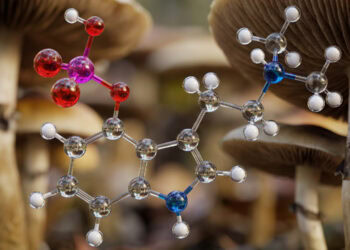
People who use psychedelic substances in an attempt to self-treat their mental health tend to report mild-to-moderate positive outcomes, according to new research published in the Journal of Psychopharmacology. But there were more negative effects reported by these individuals than in clinical settings where professionals are involved in the treatment.
There is growing evidence that psychedelic drugs may have potential in the treatment of mental health conditions, particularly when they are administered in controlled settings and combined with psychotherapy. But many people are using psychedelics to self-treat a variety of mental health conditions, highlighting the need for increased education and harm reduction strategies to minimize potential risks.
“Increasing publicity of psychedelic’s therapeutic potential is attracting growing numbers of people to ‘self-treat’ with these substances independently outside clinical settings. However, there is very little research on the patterns, outcomes, and safety of this type of use,” explained study author Emma Kopra, a PhD student at the Institute of Psychiatry at King’s College London.
The researchers were particularly interested in exploring the experiences of people who reported using either lysergic acid diethylamide (LSD) or psilocybin-containing mushrooms to self-treat mental health conditions or personal worries. For their new study, Kopra and her colleagues examined data from an anonymous online survey called the Global Drug Survey, which is available to anyone over the age of 16 with access to the internet. The survey is advertised on social media and in partnership with organizations that help reduce harm related to drug use.
More than 113,000 people completed the survey in 2020. Of those, 10,268 respondents said they had used psychedelics to treat their mental health or worries in the past year. Out of those, 55.6% had used LSD and 41.7% had used psilocybin mushrooms. In the end, a total of 3,364 people were included in the final analysis.
Respondents were asked about changes they noticed after their self-treatment, such as improvements in their well-being, social-emotional skills, and health behaviors. They also reported negative consequences, if any, and rated the intensity of these outcomes.
Depression and anxiety were the most common mental health problems that people were trying to self-treat. On average, respondents reported mild-to-moderate improvements. The top three items with the greatest mean values were changes in understanding why they feel the way they do, changes in mood or reduced depression, and changes in understanding their condition or how they relate to it.
The majority of respondents (64.3%) noticed most positive outcomes within 24 hours, and 52.7% reported positive experiences lasting at least 4 weeks. A smaller percentage (17.6%) reported positive outcomes lasting over 6 months. The time period during which people reported feeling better after taking LSD or psilocybin mushrooms was similar to the time period during which people in clinical trials experience improvements in their symptoms.
These findings are in line with previous work by Kopra and her colleagues, which indicated that psilocybin is a relatively safe drug, with only 0.2% of magic mushroom users having sought emergency medical care after use.
However, in the new study, 22.5% of the sample reported experiencing at least one negative outcome. The most commonly reported negative outcomes were mental confusion, memory problems, racing thoughts, and feeling disconnected from the world around them. Most respondents noticed the negative effects within 24 hours, but for 20.1% of respondents, the effect was noticed more than a week later. Among those reporting negative outcomes, 4.2% sought emergency medical treatment following self-treatment with LSD or psilocybin mushrooms.
The researchers said the risks involved in self-treatment appear to be greater compared to the risks involved in clinical trials of psychedelic substances. Clinical trials have shown very few cases of serious negative effects, and any negative effects that do occur are usually temporary and resolve with additional support. This suggests that proper medical supervision and therapeutic support can minimize the risk of harm associated with using psychedelic substances.
“LSD and psilocybin mushrooms are used for the self-treatment of a wide range of conditions and problems, with generally favourable outcomes,” Kopra told PsyPost. “Benefits were observed across a broad range of aspects related to wellbeing, beyond symptoms of specific psychiatric conditions, that lasted beyond three weeks for the majority of respondents in this sample. However, persisting adverse effects did appear more common than in clinical settings.”
“A number of factors were found associated with positive outcomes (higher intensity of psychedelic experience, treating with psilocybin, seeking advice before treatment, and treating PTSD) or negative outcomes (higher intensity of experience, treating with LSD, and younger age), but most of these associations were relatively small in size; this likely reflects the relative difficulty of predicting reactions to psychedelics, which are affected by complex interactions between individual differences and patterns and contexts of use.”
Psychedelics were perceived to be helpful in treating a wide range of conditions such as depression, anxiety, PTSD, bipolar disorder, and eating disorders, and psychosis. In addition, the number of negative outcomes experienced by respondents was not linked to the specific condition or problem that they were seeking to treat.
“I think one notable finding was that no psychiatric condition or other treatment indication was even weakly associated with heightened risk of negative outcomes,” Kopra said. “It is possible that certain subtypes of conditions and other individual differences in personality and personal history may be more relevant to the susceptibility to adverse reactions from psychedelics, compared to commonly recognised diagnostic entities.”
The study has some limitations. One is that the people who took part in the survey may not represent the general population. The participants were mostly young, white, and educated. The study also relied on people’s memories of their experiences, which can be biased. Furthermore, the survey may have attracted people who had positive experiences with psychedelic substances, skewing the results.
“The survey may disproportionately reach and attract certain demographics and, for example, those who have generally had positive experiences with psychedelics – people who self-treat with psychedelics is in itself a self-selective group, affecting the generalizability of identified outcomes and their predictors,” Kopra explained. “Recall biases as well as conscious attempts to influence survey results can also occur. These are issues related to most survey studies, but may be pronounced in psychedelic research, which is a heated and somewhat divisive area with topical implications to public policy and healthcare.”
“The results discussed are solely based on self-reported responses to the Global Drug Survey, and cannot be generalized to the wider population,” she added. “We emphasise that we do not promote or encourage the non-medical use of psychedelic drugs for self-treatment, as the risks are likely significantly magnified compared to risks in clinical settings.”
The study, “Investigation of self-treatment with lysergic acid diethylamide and psilocybin mushrooms: Findings from the Global Drug Survey 2020“, was authored by Emma I Kopra, Jason A Ferris, Adam R Winstock, Kim PC Kuypers, Allan H Young, and James J Rucker.