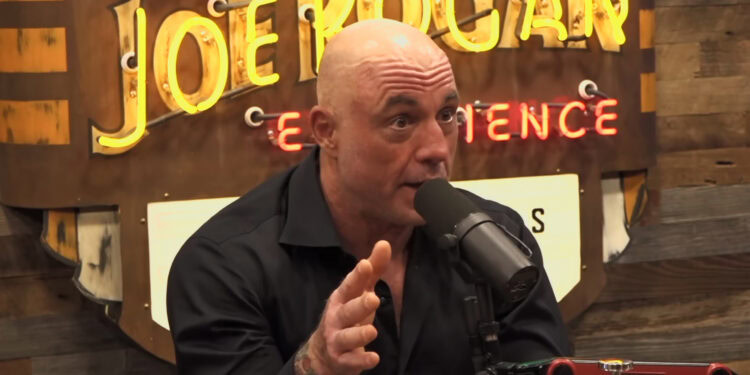
Republican voters tend to follow Donald Trump’s lead even when he takes an unpopular stance, yet new experimental research published in Public Opinion Quarterly indicates that his influence has limits. Examining the controversy over releasing government records tied to Jeffrey Epstein, the study found that pushback from Democratic lawmakers failed to dent Trump’s sway, whereas counterarguments from conservative media personalities Tucker Carlson and Joe Rogan cut his influence on policy attitudes and lowered his approval ratings. The findings suggest that apparent blind loyalty to a dominant political leader may stem less from an unbreakable cult of personality than from a shortage of trusted opposition within the leader’s own ideological camp.
Democratic government rests on political accountability, the idea that citizens monitor what elected officials do and withdraw support when leaders act against public wishes. In practice, public opinion research frequently documents the opposite pattern, known as opinion leadership, in which partisans adjust their own policy preferences to match whatever stance their favored politicians announce. For instance, a 2015 field experiment with U.S. state legislators and their constituents found that when lawmakers sent letters staking out policy positions that conflicted with voters’ earlier views, constituents tended to adopt the legislators’ positions rather than rate those officials more negatively.
No modern political figure has prompted more debate over partisan cue-following than Donald Trump. In a 2018 survey experiment with American voters, Republican participants shifted their policy views toward statements attributed to Trump regardless of whether he endorsed a conservative position or a liberal one. That pull can reach beyond everyday policy disputes, as a 2021 longitudinal study of Clinton and Trump supporters indicated that while backers of both candidates projected their own values onto their preferred nominee, only Trump supporters revised their personal moral beliefs over time to match their perceptions of him.
Commentators and political scientists have sometimes likened Trump’s relationship with his base to a cult of personality, arguing that loyal supporters accept his lead without question. At the same time, criticism from opposing-party politicians rarely weakens that allegiance; a 2020 analysis of polling trends and media cues found that messages from Democratic elites can even provoke a backlash that pushes Republicans to double down on their party’s stance. Pinpointing whether partisan loyalty has an upper ceiling remains difficult because party leaders typically champion policies their voters already favor, voters have little reason to rebel over low-stakes issues, and fellow party elites seldom break ranks publicly.
Don’t miss the next big psychology finding
Every morning, PsyPost sends a short briefing on the most interesting new peer-reviewed research in psychology and neuroscience.
To test whether Republican voters would penalize Trump under conditions that favored accountability, Love Christensen, a senior associate lecturer in the Department of Political Science at the University of Gothenburg who is also an assistant professor at Aarhus University, and Mattias Agerberg, a senior lecturer in the Department of Political Science at the University of Gothenburg, examined the controversy over the Jeffrey Epstein files.
“There is a widespread belief in both scholarship and the media that most partisans don’t care about policy and blindly follow their party’s lead regardless of what they do or what policies they adopt,” Christensen and Agerberg told PsyPost. “However, this is tricky to establish empirically, because very rarely does a party or politician take a position that is at odds with their own supporters on an important issue.”
The Epstein controversy centers on government documents tied to the late financier Jeffrey Epstein’s sex-trafficking network, including court filings, flight logs, and lists of associates and visitors to his properties. After expressing sympathy for releasing the records during the 2024 presidential campaign, Trump reversed course in 2025 and dismissed demands for transparency as a “hoax started by the Democrats.” That reversal clashed with his longstanding populist pledge to expose elite corruption, went against the roughly two-thirds of Republicans who favored disclosure in October 2025 polling, and drew vocal criticism from conservative media figures such as podcast host Joe Rogan and commentator Tucker Carlson, both of whom had endorsed Trump yet publicly urged releasing the records.
“On the Epstein issue Trump did exactly that,” the researchers explained. “This gave us the opportunity to examine whether Republican partisans, who are often portrayed as having a cult-like devotion to Donald Trump, would follow his lead on an issue which had been intensely discussed in the media and where many Republicans clearly wanted the Epstein files released. This case is important to study because if we found that Republican partisans supported Donald Trump regardless of what position he took on the Epstein files, this would be strong evidence that partisan loyalty limits voters’ ability to hold their leaders accountable.”
The authors conducted two preregistered survey experiments in September and October 2025, prior to Trump’s late November 2025 decision to release the files, and posted their replication data and documentation publicly. Although the first experiment was fielded in late October, after the late-September second experiment, the researchers present it first because it isolates Trump’s uncontested influence before the second introduces competing arguments. It was fielded later by design, as a preregistered replication of an earlier pilot, so that both main studies in the paper would be preregistered.
Using the online survey platform Cint, the researchers recruited U.S. adults whose platform profiles listed them as Republicans, retaining only participants who consented, reconfirmed their Republican identity inside the survey, and passed a preregistered attention check. Before viewing any experimental prompts, participants also indicated whether they considered themselves part of the “Make America Great Again,” or MAGA, movement.
In the first experiment, conducted in late October 2025 with 2,567 Republican respondents (2,522 in the main Epstein analysis), participants read either a real Trump statement dismissing the disclosure push as a Democratic “hoax,” an earlier Trump statement favoring release, or no statement at all. Respondents then rated their support for releasing the files on a seven-point scale. To benchmark those reactions against a more routine topic, the survey included a parallel experiment (2,516 observations) testing real Trump statements for or against sending military aid to Ukraine.
Even on this high-profile controversy, unopposed statements from Trump moved Republican opinion in whichever direction he argued. Compared with the control group, reading Trump’s argument against disclosure lowered support by 0.44 points on the seven-point scale, whereas reading his pro-disclosure argument raised support by 0.16 points.
Those shifts altered more than the intensity of attitudes: the share of Republicans opposing release more than doubled from roughly 10 percent when Trump backed disclosure to 22 percent when he opposed it. In the parallel Ukraine experiment, Trump’s statements moved support up or down by roughly 0.37 points, indicating that uncontested cue-following was just as pronounced on the Epstein files as on foreign aid.
Because showing Trump’s remarks in isolation left out the real-world pushback surrounding the Epstein files and did not test whether voters penalized him, the second experiment added competing elite arguments and direct measures of approval. Fielded in late September 2025 with 5,488 Republicans (roughly 5,480 in each main analysis), the survey assigned participants across six conditions: no statement, Trump’s anti-disclosure statement alone, or Trump’s statement paired with one of four pro-disclosure rebuttals. Those rebuttals were attributed to congressional Democrats Hakeem Jeffries and Ro Khanna, congressional Republicans Thomas Massie and James Comer, conservative media hosts Joe Rogan and Tucker Carlson, or unnamed proponents (“many people”) in an exploratory unlabeled version.
None of the rebuttals attacked Trump personally; instead, each argued that releasing the records served the public interest and was needed to restore public trust. The Democratic, Republican, and unlabeled messages used parallel wording apart from the named speakers and party labels, with the Democratic and unlabeled arms included as exploratory comparisons. The preregistered Carlson and Rogan message used direct quotes and sharper alternative-media phrasing to match how both commentators spoke in public.
Alongside the preregistered measure of support for releasing the files, the researchers tracked two exploratory indicators of political accountability: approval of Trump’s handling of the Epstein issue and overall approval of Trump.
When Trump’s anti-disclosure stance went unchallenged, Republican policy support dropped just as in the first experiment, while neither his issue-specific approval nor his overall approval fell compared with the control group. Pairing his remarks with the rebuttal from congressional Democrats produced no statistically significant difference from Trump’s unopposed statement on either policy views or approval.
Opposition from congressional Republicans Massie and Comer yielded a muted reaction: it lowered approval of Trump’s handling of the Epstein issue by 0.16 points relative to the pure control group, but its effects on policy support and approval were not statistically significant when compared directly against Trump’s unopposed statement.
By contrast, pairing Trump’s stance with the countermessage from Carlson and Rogan cut his sway over Republican policy opinion roughly in half, lifting support for releasing the files by 0.20 points above the unopposed Trump condition. Even so, policy attitudes in that group still shifted partway toward Trump’s position relative to the control group.
Voters in the Carlson and Rogan group also penalized Trump in their evaluations. Compared directly against Trump’s unopposed statement, approval of his handling of the Epstein issue dropped by 0.29 points on the seven-point scale, while a 0.15-point dip in overall approval narrowly missed statistical significance. Compared with the pure control group, issue-specific approval fell by 0.35 points and overall approval dropped by 0.22 points.
Relative to the control group, the share of Republicans approving of Trump’s handling of the controversy fell by 9 percentage points, and the share approving of him overall dropped by 8 percentage points. “The effects thus extend beyond this single issue to how Republicans evaluate Trump more broadly,” Christensen and Agerberg noted.
Results for the exploratory unlabeled rebuttal were mixed: it did not curb Trump’s influence on policy opinion or differ in a statistically significant way from his unopposed statement. Relative to the control group, however, it lowered the share of respondents approving of Trump overall by about 7 percentage points, nearly matching the drop in the Carlson and Rogan condition. The authors note that this uneven pattern could reflect random sampling variation or respondents making their own inferences about who was behind the unnamed argument.
To check whether the backlash came mainly from less devoted party members, the authors analyzed the roughly half of respondents who identified as MAGA Republicans separately from other Republicans. MAGA identifiers showed much deeper loyalty to Trump on other benchmarks, with 72 percent saying the 2020 election was stolen compared with 42 percent of other Republicans, and nearly twice as many saying he should run again, yet both groups backed releasing the Epstein files at similar rates (82 percent and 85 percent).
When Trump spoke unopposed, MAGA identifiers followed his policy cues if anything slightly more strongly in both directions than the full sample. Yet they penalized him more than other Republicans for opposing disclosure: overall approval of Trump among MAGA identifiers fell across every condition that showed his anti-release stance, even when it went unchallenged. Pairing his position with the Carlson and Rogan rebuttal produced the steepest drops in both cue-following and approval. In the authors’ assessment, MAGA respondents behaved slightly closer to textbook issue voters on the Epstein files than non-MAGA Republicans, though a smaller subset of unconditional loyalists may still exist within the movement.
“One surprising finding was that self-identified MAGA Republicans were, if anything, more willing to hold Trump accountable on the Epstein issue than Republicans overall,” the authors said. “This suggests that even strong identification with the MAGA movement does not necessarily translate into unquestioning loyalty to Trump.”
The researchers also examined more than 5,300 open-ended written explanations in which Study 2 participants described why they thought Trump had acted as he had on the Epstein files. They classified the answers using an artificial intelligence language model that achieved 98 percent accuracy against a hand-coded subset of 293 responses, applying a statistical adjustment to account for any remaining classification errors.
Reading Trump’s uncontested statement raised the share of respondents who dismissed the Epstein controversy as unimportant or a distraction by 8.4 percentage points over the control group, and the Democratic rebuttal failed to curb that uptake. Pairing Trump’s remarks with the Carlson and Rogan rebuttal, however, produced a statistically reliable reduction compared with Trump’s uncontested statement, shrinking the increase to 1.3 percentage points above the control group. At that point, the difference from the control condition was no longer statistically significant.
Why did conservative media commentators succeed where elected lawmakers fell short? Drawing on political persuasion theory, the authors suggest that counterarguments carry more weight when voters recognize the messenger and believe that person shares their underlying concerns. In an exploratory third survey of 537 Republicans conducted in mid-October 2025, name recognition stood out as the sharpest divide: roughly 70 percent of respondents were familiar with Rogan and Carlson, compared with about a third who knew Comer or Massie.
Respondents also rated the two media hosts as sharing their concerns on the Epstein files far more than the Democratic lawmakers and modestly more than Comer and Massie specifically (among the 409 respondents asked about individual lawmakers), though no higher than Trump or congressional Republicans as a broad group.
Weeks after the experiments concluded, in late November 2025, Trump reversed course and agreed to release the Epstein records rather than veto disclosure. In the authors’ reading, Trump appeared to judge the political cost of blocking release as too high, an outcome that aligns with their experimental evidence on the price of dissent within his own camp.
Meanwhile, the inability of Democratic lawmakers to dent Trump’s standing aligns with an earlier experiment with American voters examining reactions to Trump’s federal criminal prosecution. In that study, elite rhetoric attacking the prosecution had no statistically significant effect on public attitudes, while legal arguments defending it lowered support for Trump among non-supporters yet heightened hostility toward the prosecutor among his backers. That earlier work tested messaging around a criminal case rather than policy rebuttals from voices inside the conservative movement, helping explain why internal conservative dissent succeeded where outside criticism fell flat.
“Even powerful and charismatic politicians can be held accountable by their own supporters, but to do so the partisans need help from a trusted opposition,” Christensen and Agerberg pointed out. “In a polarized system such as the US, effective opposition may need to come from within the politician’s own ideological camp.”
“The takeaway is that seemingly unwavering loyalty does not necessarily mean voters are blindly devoted to a leader,” the researchers added. “It may also reflect a lack of credible opposition. When people they trust challenge that leader, even loyal supporters can be willing to hold him accountable.”
As with all research, there are some caveats to consider. Because the Carlson and Rogan rebuttal used direct quotes and sharper alternative-media language to sound authentic while the congressional rebuttals used identical, more formal wording, the experiment tested a realistic bundled message and cannot isolate how much of the effect came from the commentators’ identities versus their rhetorical style.
In addition, the Epstein controversy offered unusually favorable conditions for accountability, combining heavy bipartisan news coverage, strong preexisting Republican support for transparency, and open pushback from prominent right-wing hosts; on less visible issues where conservative media figures stay silent or echo Trump, partisan loyalty may face far fewer checks.
Because the Epstein debate was already heavily publicized when the surveys ran, the experiments measured the added impact of highlighting elite stances rather than persuasion on an unfamiliar topic. The third survey measuring familiarity and shared concerns also relied on a separate exploratory sample rather than the Study 2 participants themselves, and all three samples were drawn from an unweighted opt-in online panel rather than a random probability sample of all U.S. Republicans, though their demographic makeup matched reasonably well with unweighted Republican respondents in the 2024 American National Election Studies.
Future research, the authors note, will need to examine what makes political opposition credible across a wider range of issues and leaders in polarized democracies.
The study, “Cult of Personality or Lack of Competition? Determining Trump’s Sway Over Republican Partisans on a Critical Case,” was authored by Love Christensen and Mattias Agerberg.
